
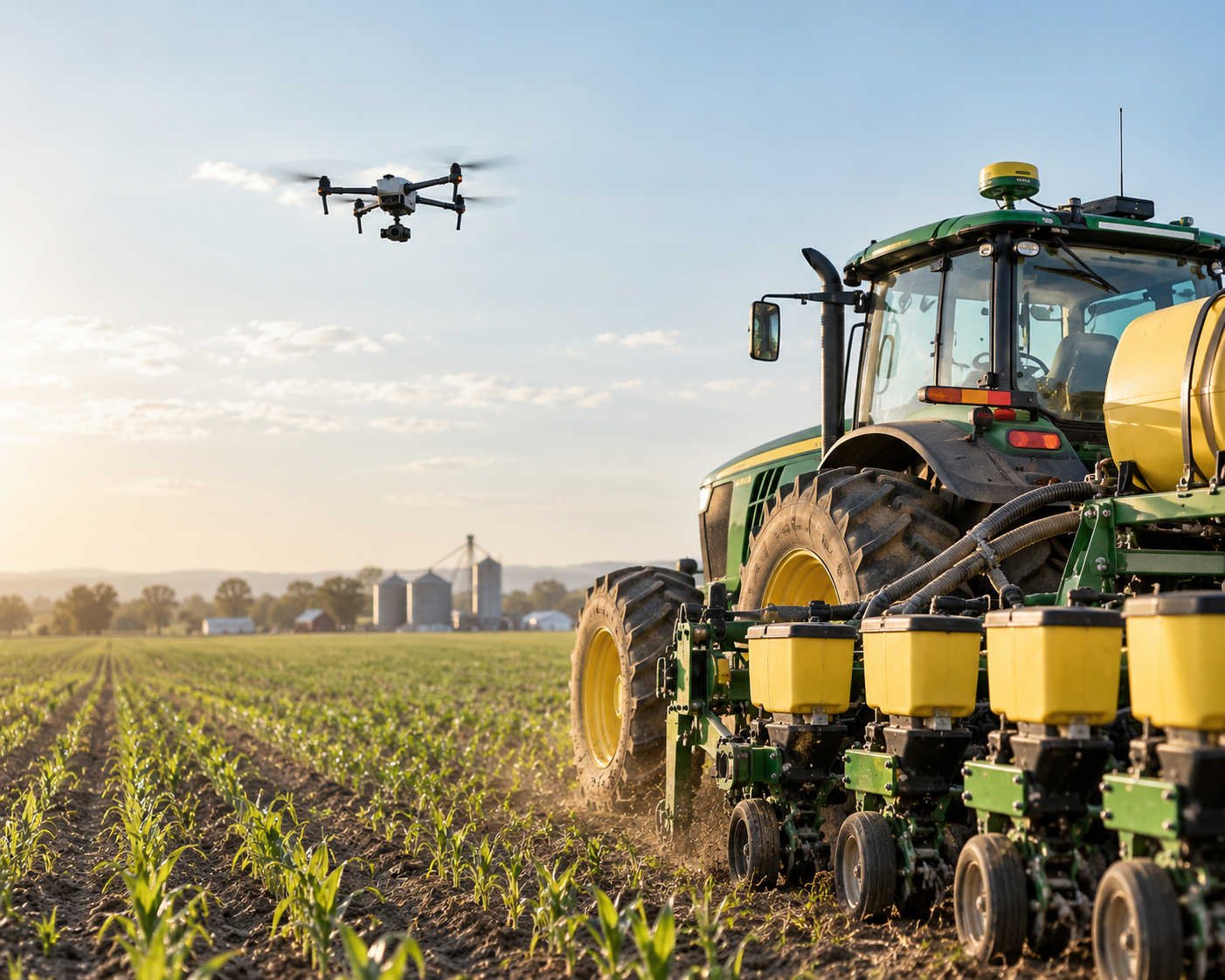
A modern farm operation can have $400,000 or more invested in GPS systems, drones, sensors, and farm management software. Standard farmowners policies were written before any of that existed. Here is the gap, and what to do about it.
Picture this. It is the first week of May, prime corn planting window. Your tractor's Global Positioning System (GPS) auto-steer receiver drops a signal for 22 minutes on a field pass. The variable-rate technology (VRT) controller keeps running. Your planter keeps dropping seed. But it is running off a stale prescription because the GPS and the rate controller lost sync, so you have planted 18 acres at 32,000 seeds per acre when the prescription called for 26,000. You catch it at the end of the pass. The seed is in the ground. The stand will be uneven. The equipment never broke. The software just did something your policy did not anticipate.
You call your agent. The adjuster confirms what the policy says: equipment breakdown coverage requires a mechanical or electrical failure causing direct physical loss. A software sync error does not qualify. The seed cost and the agronomic loss are yours.
This kind of scenario used to be hypothetical. Now it happens every planting season on farms running precision ag systems, because those systems introduce a class of risk that standard farmowners policies were not built to cover.
What Precision Agriculture Actually Costs
The U.S. Department of Agriculture (USDA) has tracked precision agriculture adoption for more than a decade. GPS guidance and auto-steer are now standard on the majority of large commercial grain operations. Variable-rate seeding, fertilizer, and application systems are common. Drones are ubiquitous for crop scouting, and an increasing share of operations are using them for spraying.[1]
Add it up on a modern row crop or specialty crop operation and the precision technology investment is substantial:
- GPS receiver and auto-steer system: $15,000 to $35,000 per tractor or planter
- Variable-rate controller and prescription software: $8,000 to $25,000
- Commercial agricultural drone (scout or spray capable): $15,000 to $80,000
- Farm management software (FMS) platform subscription: $5,000 to $25,000 per year for large operations
- Yield monitors, soil sensors, and Internet of Things (IoT) connectivity hardware: $10,000 to $50,000
A well-equipped 2,000-acre grain operation can easily have $200,000 to $400,000 in precision technology alone, separate from the tractors and equipment it rides on. That technology also holds the farm's most operationally critical data: multi-year yield maps, soil sampling grids, planting prescriptions, and agronomic records that took years to build.
None of that is covered the way farmers assume it is.
Three Gaps Your Policy Was Not Designed For
Technology errors and consequential crop loss. Standard farmowners policies cover physical damage to physical property. When a software glitch, GPS signal error, sensor failure, or cloud-platform outage causes a wrong application rate or a missed critical window, there is no physical damage to equipment. The equipment worked. The software did not. The policy does not respond.
The specific scenarios that fall into this gap include: a VRT controller applying fertilizer at the wrong rate due to a prescription file error, an auto-steer drift causing row overlap or skips across 20 or more acres, a smart irrigation system failing to run due to a connectivity fault, and a planting prescription loaded with the wrong variety map triggering a wrong hybrid across multiple fields. Each of those produces real agronomic and financial loss. None of them triggers a standard policy.
Cyber and data risks. The FBI (Federal Bureau of Investigation) and the Cybersecurity and Infrastructure Security Agency (CISA) have both issued advisories warning that the agriculture sector is an active target for ransomware and cyber intrusion.[2] Farm management software platforms hold financial records, yield histories, soil data, and field maps that represent years of accumulated operational intelligence. Irrigation systems connected to the internet are accessible remotely. Equipment telematics expose GPS location and operational data.
Standard farmowners policies now routinely include explicit cyber exclusions. A ransomware attack that encrypts a farm's entire yield and prescription database, or a remote intrusion that triggers an irrigation cycle at the wrong time, produces losses your policy will not cover.
Drone liability and Federal Aviation Administration (FAA) compliance exposure. Commercial drone use in agriculture is governed by FAA Part 107 regulations, which require remote pilot certification, restrict operating conditions, and create specific liability exposure for incidents involving neighboring property, livestock, or people.[3] A spray drone with a chemical drift incident, a scouting drone that crashes into an adjacent orchard, or an image-data dispute over footage captured across a fence line all produce liability that standard farm policies are not structured to address. Most farm liability policies either sublimit unmanned aircraft coverage significantly or exclude it altogether.
Your policy was written before your equipment could think. The gaps are not hypothetical. They are the logical outcome of applying a 20th-century product to a 21st-century operation.
Why Standard Policies Read Like They Were Written 30 Years Ago
Because for practical purposes, they were. The coverage structure in a standard farmowners policy has not fundamentally changed to accommodate precision agriculture. The modifications that carriers have made are mostly subtractive: cyber exclusions added, drone coverage sublimited, software errors excluded from equipment breakdown definitions.
This is partly because standard insurance carriers price across broad populations. A precision technology errors policy written for a $2,000-acre corn operation is too narrow for a carrier with 50,000 farm policyholders to profitably administer. The margins are not there for bespoke coverage, so the coverage does not exist in the commercial market. You either go bare on those risks or you find a structure that lets you write terms that actually match your operation.
That structure is a captive insurance company.
What a Captive Can Write That a Carrier Won't
A captive is a licensed insurance company owned by the business it insures. Because you own the entity, you set the terms. That means you can write coverage for exactly the risks that commercial carriers exclude.
For a precision agriculture operation, that typically includes:
- Technology errors and consequential crop loss, covering agronomic losses caused by software, GPS, sensor, or connectivity failures that do not involve physical equipment damage
- Cyber and data loss coverage, tailored to farm management platforms, yield databases, and connected equipment, without the blanket exclusions standard policies contain
- Drone liability without the sublimits, including spray drift, collision, and image-data incidents, with terms that reflect actual FAA Part 107 compliance requirements
- Business interruption tied to precision technology failure, covering lost production from a planting or harvest window missed due to a tech failure, not just a fire or windstorm
The captive does not replace your commercial program. Your standard farmowners policy stays in place for what it is good at. The captive covers what the commercial market will not write.
And because you own the captive, your favorable loss years build your reserve instead of someone else's margin. An operation with good agronomic discipline and a solid loss history should not be paying commercial rates that are priced across every operation in the market.
Does Your Operation Qualify?
Four questions worth asking:
- Is your total annual insurance spend $250,000 or more across all lines?
- Has your loss history been favorable over the last five years?
- Do you have more than $100,000 in precision ag systems currently uninsured for software errors, cyber events, or drone incidents?
- Are your premiums increasing while your claims record stays clean?
Two or more yeses and the conversation is worth having.
A note on legitimacy: captive insurance has a clear regulatory and tax structure. Internal Revenue Code Section 831(b) governs small captives. Premiums paid to the captive are a tax deduction for the parent farm entity. Underwriting income is excluded from taxable income up to the annual limit. The Internal Revenue Service (IRS) published final regulations in January 2025 addressing micro-captive structures. Legitimately formed captives, built to cover real economic risk with reasonable premium pricing, operate cleanly under that framework.
Start with the Policy You Already Have
Most farm operators with precision agriculture systems have never had anyone read their insurance policies against what those systems actually do. That is where the conversation starts.
A no-cost policy analysis from 3F Captive Services maps your precision ag risk profile against your current coverage, identifies the specific gaps in your farmowners, equipment, liability, and crop policies, and determines whether your operation's profile fits a captive structure.
You already know the technology changed your operation. Find out if your insurance kept up.
No-cost analysis. No obligation. Contact 3F Captive Services at 3fcaptiveservices.com.
This post is for informational purposes only and does not constitute insurance, legal, or tax advice. Captive insurance structures involve complex regulatory and tax considerations that vary by jurisdiction, entity type, and specific facts. Consult qualified insurance, legal, and tax advisors regarding your specific situation.
Sources
[1] USDA Economic Research Service. Precision Agriculture: USDA Efforts and the Landscape of Adoption. ers.usda.gov/topics/farm-practices-management/precision-agriculture/
[2] FBI and CISA. Cybersecurity Advisory: Ransomware Attacks on Agriculture Cooperatives. cisa.gov / ic3.gov. Advisory issued April 2022 warning of ransomware threats to agricultural operations during critical planting and harvest seasons.
[3] Federal Aviation Administration. FAA Part 107 — Small Unmanned Aircraft Systems Regulations. faa.gov/uas/commercial_operators. Governs commercial drone use in agriculture including certification requirements, operating conditions, and liability framework.
Discover Tailored Insurance Solutions
Unlock the potential of customized captive insurance designed specifically for your unique business needs.