
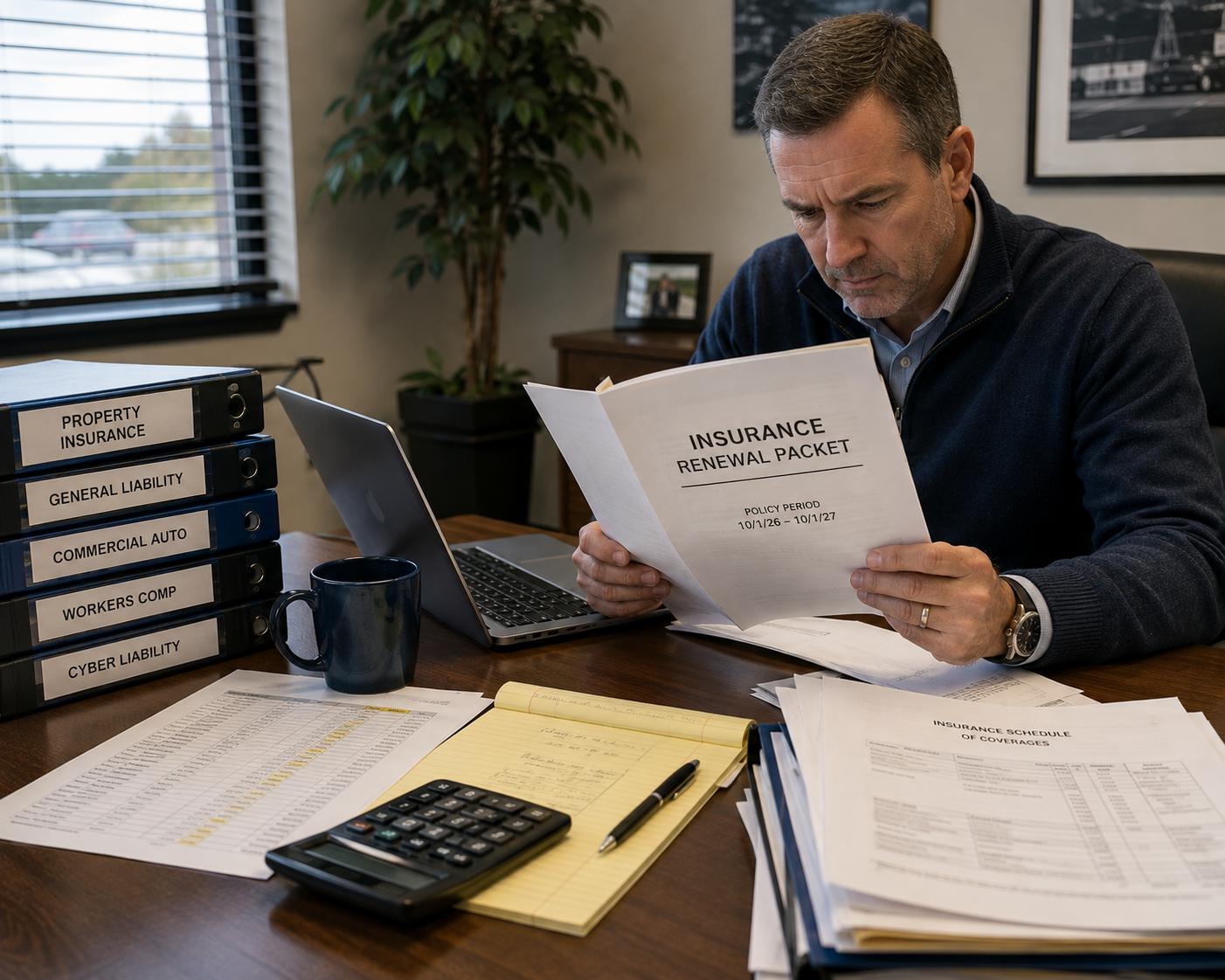
Is my business underinsured? Nobody asks that question until after a claim, when the adjuster explains what the policy actually pays and the answer arrives too late to do anything about it.
Underinsured Doesn't Mean No Coverage
Most underinsured businesses aren't walking around with no coverage at all. They have a policy, an agent, a renewal date circled on the calendar, and a quiet assumption that the number on the declarations page means what it sounds like it means. The real gap usually isn't coverage that's missing. It's coverage that hasn't kept pace with what the business is actually worth, sitting there unnoticed until a claim forces the math into the open.
Property insurance carries this risk in a piece of fine print called a coinsurance clause, and it is worth understanding even if you have never read your own policy that closely. Most commercial property policies require you to insure a building to a set percentage of its replacement cost, commonly 80 percent. Fall short of that percentage and the insurer doesn't just deny the difference. It reduces the entire payout, proportionally, even on a loss that only damaged part of the building. Here's exactly what that costs in real dollars.
Here's an illustrative example, not a real claim. A business owns a building that would cost $2,000,000 to rebuild today, but the policy has carried a $1,400,000 insured value for a few renewal cycles, back when construction costs were lower and nobody thought to revisit the number. A fire causes $500,000 in damage. The policy required 80 percent of value, or $1,600,000, and the business only carried $1,400,000, so the insurer pays $1,400,000 divided by $1,600,000, times the loss. That works out to roughly 87.5 percent of $500,000, or $437,500. The business absorbs the remaining $62,500 itself, on top of whatever deductible applies, not because anything was excluded, but because the insured value quietly fell behind the real cost of rebuilding.
Why the Gap Keeps Widening
That gap doesn't stay still. Construction costs, wages, and equipment prices move every year, and a policy renewed on autopilot at last year's number falls further behind each time it renews unchanged. Deloitte's 2026 insurance outlook points to a widening global protection gap even as carriers face their own margin pressure from trade policy uncertainty, supply chain disruption, and labor shortages, the same forces pushing rebuild costs higher for the businesses buying the coverage. The same report notes that large corporates are increasingly self-insuring through captives, which is worth sitting with for a second. The businesses with the most sophisticated risk management in the country are moving toward owning more of their own risk, not less. A mid-market owner who assumes a captive is a strategy for someone bigger than them is behind that curve, not ahead of it.
It Isn't Only the Building
The coinsurance clause is the clearest version of this problem because the math is so explicit, but the same underinsurance pattern shows up everywhere else on a renewal. A cyber sublimit set two years ago against a smaller, calmer threat landscape. An employment practices liability limit that hasn't moved since the business had half as many employees. A general liability program priced for a claims history that no longer matches how the business actually operates today. None of it looks like a gap from the outside. It only becomes one at the worst possible moment, which is exactly when insurers have the least incentive to make it easy. Nationally, insurers deny roughly half of all property and casualty claims filed, and the lines that get the least attention on renewal are usually the ones carrying the most exposure.
What a Captive Actually Does About the Gap
A captive doesn't make the commercial market disappear, and it isn't a replacement for the primary coverage a lender or a contract requires. What it does is give a business somewhere to put the risk it's currently absorbing for free, in the years the claims stay quiet.
- Builds the reserve while the losses stay quiet. Under Section 831(b) of the Internal Revenue Code (IRC), premiums paid into a qualifying captive are deductible by the parent company, and the underwriting income inside the captive is generally not taxed to the captive itself, up to the 831(b) limit. Say a business funds $175,000 a year into its captive during a stretch with no major claims. Three years later, that reserve has grown past $600,000, sitting there specifically because the quiet years funded it, ready to cover a coinsurance shortfall or a sublimit gap without a scramble. This is illustrative, not a specific client's numbers. The captive's own investment income is still taxed, but only once it's realized, meaning interest, dividends, and gains when an asset is actually sold. Unrealized gains sitting in the portfolio aren't taxed until they are, which can be a meaningful difference over time. Realized investment income is taxed at the flat 21 percent federal corporate rate under IRC Section 11, generally lower than the top individual rate that money would otherwise face outside the captive.
- Funds the deductible you keep raising to hold the renewal number flat. If a soft quarter pushes a business to raise its property or liability retention just to keep the premium from climbing, the captive can be structured to absorb that layer instead of the business's working capital.
- Keeps insured values honest. Because the captive is reviewed and funded every year as part of the business's own program, the replacement-cost conversation happens on a schedule instead of getting skipped for three renewal cycles in a row.
- Rewards the risk management the business is already doing. A standard commercial policy prices a business's premium off the average claims history of every similar business the carrier insures, so running safer than that average mostly subsidizes the ones that don't. A captive prices the business against its own claims history instead, so real investment in safety and loss prevention shows up as savings the business actually keeps.
Who This Is For
As a general guideline, not a hard rule, businesses spending $250,000 or more a year across their full insurance program, property, liability, workers' compensation, and whatever else sits on the renewal, tend to fall in the range where a captive feasibility study shows significant economic value year after year. That threshold can run lower in high-tax states, where the 831(b) benefit strengthens the case before the loss numbers alone would justify the cost of forming the structure.
The clearest fit is a business owner who has never actually recalculated what it would cost to rebuild, replace, or restaff the business from a standing start, and who would rather find that number on their own schedule than learn it from an adjuster.
Contact 3F Captive Services for a no-cost policy analysis of your business's current insurance program. No pressure, no commitment, just a clear look at where the coverage you're paying for actually stands against what it would take to make you whole.
This article is for general informational purposes only and does not constitute insurance, legal, or tax advice. Coverage availability, captive insurance suitability, and applicable regulatory requirements vary and are subject to change. Consult qualified insurance, legal, and tax advisors regarding your specific situation.
Sources
1. Deloitte Center for Financial Services. “2026 Insurance Outlook.” Deloitte, October 9, 2025. https://www.deloitte.com/us/en/insights/industry/financial-services/financial-services-industry-outlooks/insurance-industry-outlook.html
2. Shearer, Brian. “Regulating Insurance as a Public Utility.” Forthcoming, Columbia Business Law Review (April 2026). NAIC 2024 Market Share Reports.
3. Internal Revenue Code Sections 831(b) and 11. Captive insurance company and corporate tax treatment.
Discover Tailored Insurance Solutions
Unlock the potential of customized captive insurance designed specifically for your unique business needs.