
If your company's claims history is clean and your premiums still rise every year, it's fair to ask who's benefiting from your good record. In the traditional market, the answer usually isn't you.
Every company already self-insures for whatever its policies don't cover. The real question is whether it's doing that efficiently. A captive, an insurance company your business owns, is one way to take control of that risk. It sits alongside the coverage you already have, not in place of it.
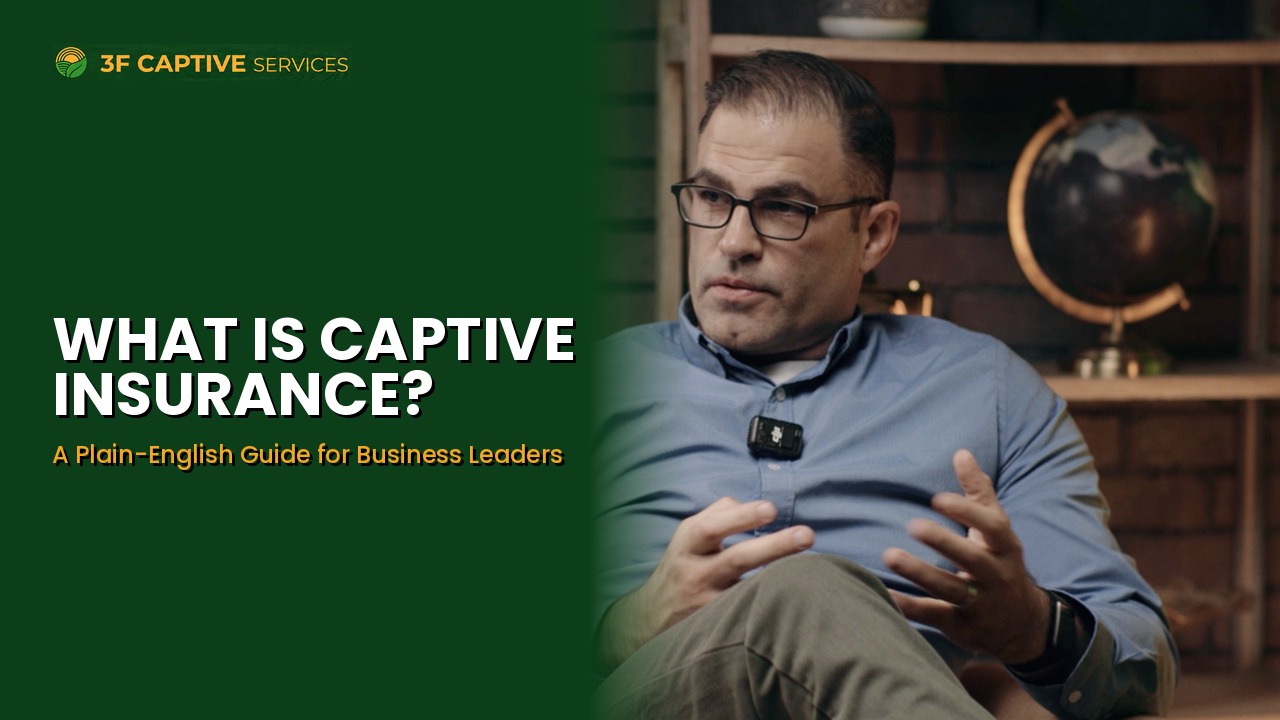
In this first session of the 3F Intelligence Series, Patrick Johnston and I explain captive insurance in plain English: what it is, who it fits, and how to find out if it makes sense for your company.
What we cover
- Why every company already self-insures
- What a captive is, and why it's a real, regulated insurance company you own
- How a captive works alongside your existing policies
- Determining if your company is a candidate
- What our free policy analysis involves, with results in under a week
- A real example: a denied equipment claim, and how a captive policy now backs it up
- Viewer questions: keeping your broker, bad claims years, cannabis operators and more
It works alongside your insurance
A captive doesn't replace your commercial policies, and you don't need to change brokers. We look at what you already have, find the gaps, and design coverage for the risks your current policies leave out or price too high.
Start by knowing where you're covered
Send us your current policies and we'll run a free analysis. Most results come back in under a week. Even if a captive isn't the right fit, you'll know exactly where you're covered and where you're not.
Introducing 3F: Transcript
Robert O'Shaughnessy [0:05]
I'm Robert O'Shaughnessy. I am the founder of OE Communications. I'm a marketing and communications strategist. And I'm here today with Jonathan Strike and Patrick Johnston, co-founders of 3F Captive Services. Jonathan Strike earned his MBA at Stanford. Patrick got his MBA at the Kellogg School of Management. Together, they co-founded 3F Captive Services to help clients manage risk and to turn the red line insurance costs into a source of financial strength.
Robert O'Shaughnessy [0:34]
Welcome guys. Patrick, let's imagine a mid sized business, clean claims history, it's well run and the premiums are nonetheless rising every year. Who benefits from that good track record? It's it's not them.
Patrick Johnston [0:48]
Well, your insurance company benefits from your clean track record, your traditional insurance company, because you're keeping keeping your claims low, their expenses low, while paying them higher premiums every year. The question is, where's all that money going? Right? It's covering the overhead of the traditional insurance companies, it's covering their salaries, it's covering profit. All that is lost to you and it's a it's a benefit to the traditional insurance company. So it's
Robert O'Shaughnessy [1:17]
Structural.
Patrick Johnston [1:18]
It's it's it's exactly structural. That's the way the system is set up. The traditional insurance companies are profit centers, they make a lot of money. And you know, it's if you have low claims, you're benefiting them and the pool, not yourself.
Robert O'Shaughnessy [1:30]
Patrick, could you explain structurally why even good businesses, clean claims history, are nonetheless being punished?
Patrick Johnston [1:39]
You have to remember that every company self-insures. Everything that's not covered by the traditional insurance policies for that company, they're self-insuring that by definition. The question is not if the company is self-insuring, it is whether they are doing it efficiently. That's the real question. A recent study of Vanderbilt showed that for every dollar that workers' comp insurance companies collect in premiums, they pay out only 50 cents for claims. That Vanderbilt study.
Patrick Johnston [2:10]
Showed that across all P&C lines in 2024, 62 cents of every dollar was paid out in claims. Whereas in the late 80s and 90s, those insurance companies paid out 80 cents of every dollar collected. According to the same Vanderbilt study, 50% of all P&C claims are initially denied by the insurance carrier. But upon appeal,
Patrick Johnston [2:39]
That denial was only held up in two percent of those cases.
Jonathan Strike [2:44]
In the commercial market a good operator is is basically subsidizing the the claims performance or the poor operations of other companies in the pool. So if you're if you're in a specific industry and your claims, the number of claims and loss of areas are below average, you're paying the same rate as average operators or poor operators. So you're effectively subsidizing it. There's really no way to get out of that.
Jonathan Strike [3:13]
Construct in the if you're paying traditional commercial claims, you have to look at alternatives. And that's where something like captive insurance comes in.
Robert O'Shaughnessy [3:21]
So how would you characterize the like fundamentals of the structure of the traditional insurance model?
Jonathan Strike [3:27]
Well, the traditional insurance model is structured to benefit the insurance companies. Right. So it's like, you know, the the the insurance companies don't underwrite policies to lose money. They know what they're doing, they have a long operating history. So they're not stupid. Right. So they structure their businesses to maximize their profits. What does that mean? It means even if you're a good operator, you're seeing your insurance costs rise year over year and you're seeing exclusions increase.
Robert O'Shaughnessy [3:55]
Is there a structure that changes that equation?
Jonathan Strike [3:58]
Yeah, the only the only insurance structure that can change that equation is setting up your own insurance company, which is what captive insurance is.
Robert O'Shaughnessy [4:08]
Let's get into this a little bit deeper. There's this word captive, right? Like I don't want a captive to anything. And yet here we are saying, you should get this captive insurance company.
Patrick Johnston [4:21]
Well, it is a terrible name. We didn't come up with it, right? but again, it's an insurance company that is formed by a parent company to insure the risk of that parent company. And that parent company participates in the economics, specifically the underwriting profits of that insurance company. So you've taken yourself out of the pool. You now are insuring your own risk with your own company, and if you keep your losses low.
Patrick Johnston [4:48]
then your insurance company profits and you get the benefit of that directly. Yes, it's a it's a fully regulated and legal insurance company that you own.
Robert O'Shaughnessy [4:53]
So it's a real insurance company.
Robert O'Shaughnessy [5:02]
And could you tell us about exposure risk and how the captive sort of serves to cover the risk, the exposure that you might be facing?
Patrick Johnston [5:11]
Sure. one of the great beauties of a captive insurance company is because you own it, you get to design the insurance policies, of course, with the help of actuaries, right, who price those policies. But that means that you can design policies that fit your company exactly rather than an off-the-shelf policy that a traditional insurance company puts out for a whole group of companies. That's much more vanilla, but you can design these to be specifically.
Patrick Johnston [5:40]
specifically to protect the exact risks that your business faces, right? And th oftentimes those risks are ones that cannot be covered or are not covered by traditional insurance companies.
Robert O'Shaughnessy [5:51]
And what happens with reserves if there are no claims filed?
Patrick Johnston [5:55]
Same thing that happens with a traditional insurance company. They stay in the insurance company, they stay in your captive insurance company, those those reserves are invested, they compound over time. The big difference is they're your funds. So with a traditional insurance company, you're a customer. Your business is a customer. And the underwriting profits flow to the traditional insurance company and to the shareholders of the traditional insurance company. Whereas with a captive, those
Patrick Johnston [6:23]
those profits, those underwriting profits stay in the company that you own and you control, your captive insurance company.
Robert O'Shaughnessy [6:30]
So you're not asking your clients to become insurance experts over money.
Patrick Johnston [6:36]
We're not asking them to become insurance experts ever. They need to be experts in their business, which they already are. They need to have an understanding of the risk their business faces, right? And that helps us working with them to form a captive insurance company that best covers the risks of their company and leaves them in the best economic position possible.
Jonathan Strike [6:55]
For example, over 90% of Fortune 500 companies have at least one in place and they can take different forms. What we do is more along the lines of what's called a single parent captive, where the the operating business or businesses own the captive outright. So they don't share ownership. And that can take you know several different forms. Some companies, large companies can set up their own single parent captive.
Jonathan Strike [7:19]
We have what's called a cell structure, which eliminates a lot of overhead and our costs are lower to set it up, but the ownership still stays with the operating business owners 100%. So they're not sharing ownership with other with other entities or or or people. And we cover risks that are not available in those in those markets.
Robert O'Shaughnessy [7:39]
So would you say that the right structure would depend on what client, the industry, business type?
Jonathan Strike [7:48]
no, I wouldn't say it's depend industry dependent. I think it's more dependent on what the risk the of the business
Robert O'Shaughnessy [7:54]
So I'd like to give our audience a chance to think about this and think about in the context of their own business, right? So for those watching us here today, what would you say to them if the goal is to help them self qualify and and see if this is a conversation worth having?
Patrick Johnston [8:09]
Well I'd ask you I'd ask yourself these questions about your business. Is your total insurance spend at or above two hundred fifty thousand dollars a year across all lines? Do you have a pretty clean claims history of the last five years? Do you have any denied claims or gaps in your coverage that you may know now or that you found out after the fact? And the last question I might ask is, are your insurance premiums going up while your losses are going down?
Robert O'Shaughnessy [8:38]
Let's talk a little bit now about an analysis that perhaps you guys could help folks with. You know, what should people do if they're interested in having a conversation and looking at their own
Patrick Johnston [8:49]
It's very simple. Pick up the phone and give us a call. We have a can have an initial discussion. We usually know pretty quickly after talking to a company about sort of the business and their insurance coverage and and what they're doing, we get a pretty good idea if it'll work. And maybe most importantly, what we offer is a free analysis of their current policies. And if they never work with us, that's still a very valuable step because what they will take from that is a better knowledge of where they actually are covered and where they are uncovered. Most folks don't know that.
Patrick Johnston [9:19]
Right? Until it's too late.
Jonathan Strike [9:22]
Usually what we do is an initial conversation and then we like to get their full existing policies that we can do a very comprehensive analysis in a under a week. It gives them an idea. we don't charge for that. I mean, really what the that analysis is designed to do is to look at their commercial their current commercial coverages, identify the gaps in their coverages relative to the risks the business face, and then layering where a captive insurance program might help.
Jonathan Strike [9:51]
And that that costs nothing.
Patrick Johnston [9:53]
The company will walk away, if nothing else, with a much better l understanding of where they are well covered, where they might not be well covered, and where they're definitely not covered.
Jonathan Strike [10:03]
If it looks like the ca a captive will make sense and the client wants to move forward, then we move into what's called the feasibility study. So a feasibility study is where we collect de more detailed financial information from the business, more detailed information about their operations, their loss history, things like that. And then we work with third party actuaries to basically price a whole suite of potential coverages in their captive.
Jonathan Strike [10:30]
along with a full blown financial analysis and financial projections of the captive insurance entity. And that process usually takes between sixty and ninety days to to complete. And it that's actually when the client or or the prospective client will start paying money. And the feasibility studies cost around twenty five to thirty K.
Patrick Johnston [10:51]
The other element of that is out of the feasibility study. We work with the company itself to figure out what policies specifically to put into the captive or to to have available to the captive. And that is a very customized process. What we put together for company A will be totally different than what we put together for company B. So those policies are all designed for the parent company. And we don't know what that looks like till we get in there and do that work with them.
Jonathan Strike [11:19]
One of the things that we really emphasize with clients is that captive insurance is not a replacement for your traditional commercial policies. So anything that we do with a client sits side by side or on top of their existing commercial coverages.
Robert O'Shaughnessy [11:35]
So it's like the captive kind of just like runs in the background. It it
Jonathan Strike [11:40]
it you could say that. I I I mean I think the you know, running in the background implies that the the captive insurance company is an important I would say it's very important because it's coveraging it's covering risks that their existing insurance doesn't. And they're also getting the and the clients also getting the benefit of the retention of their own insurance premium. So remember, premiums paid in the commercial carriers sit with the carriers.
Jonathan Strike [12:07]
Premiums paid into a company's captive insurance program sit with the company. So they're keeping those premiums.
Patrick Johnston [12:13]
Think of the two pe the pieces as fitting together because the other thing that the captive insurance company can do, not only fill the gaps where the traditional insurance company doesn't offer coverage, but also it can cover limits and sublimits of the traditional policies, deductibles, so it works directly with the traditional insurance policies to fully round out the risk management of the parent company.
Robert O'Shaughnessy [12:37]
In your experience, would you say that your clients have had a thorough look at their own policies?
Jonathan Strike [12:45]
No. The short answer is no. I mean, these things are so can be several hundred pages long. And so we for example, we had a client who had a I don't know, he had a tractor loss. Tractor loss. Yeah. And what was the
Patrick Johnston [13:00]
So our client had a tractor loss, and they thought that of course their equipment policy was going to cover that. It was a very, very expensive loss. And what they found out later, the claim was denied. So there they are with an equipment policy that they believe is covering all these kinds of equipment breakdowns. But there are very important gaps in that policy. And this this particular incident fell in there.
Patrick Johnston [13:25]
So the first thing we did for this existing client is they turned to us, they said, what can we do? And we designed what's called the difference in conditions policy that sits alongside, they still have their equipment policy, but it sits alongside that equipment policy such that if they have another event like that where the where the [traditional] policy does not pay the claim, the captive policy is designed to back that up and cover that.
Jonathan Strike [13:49]
And this was this was a material loss. It was several hundred thousand dollars.
Robert O'Shaughnessy [13:53]
Guys, we're gonna get into some questions that have been submitted to us before filming here today. before we get to those questions though, I just wanna give you a chance to summarize what you hope are the key takeaways of this conversation so far.
Jonathan Strike [14:05]
Sure. I I think there are two or three key takeaways here. I I think the first is to understand that captive insurance does not work like traditional insurance. So unlike traditional insurance, where you pay the premiums and the traditional insurance carrier keeps the premiums, you're paying premiums in your own entity, your own captive insurance company, and you keep those premiums. So it's a very different, it doesn't work like traditional insurance. the second main point is that.
Jonathan Strike [14:34]
it's not a replacement for your current insurance policies. It's a supplement to it. So it can cover gaps in coverage or it can cover risks that just aren't available to or not available to be covered in the commercial markets.
Patrick Johnston [14:48]
You need to know where you're self-insuring and and we can help you with that. That's a very, very powerful information. And then if you're not comfortable with the amount that you're self-insuring or you have risks out there that make you uncomfortable, that's a perfect place to start the captive insurance conversation. The structure of the traditional insurance market is not designed to
Patrick Johnston [15:09]
be customized for individual companies. It's customized for a huge pool of of insurees. What a captive does is says, okay, if you don't quite fit that perfectly or you're not comfortable fitting into that pool, then a captive is a very good solution because it's so customizable. And again, because you are paying your own company and if you keep your losses low, you enjoy directly the benefit of your good loss history.
Robert O'Shaughnessy [15:38]
Let's imagine those small or medium sized business owners watching this right now and they're hearing about captive insurance for the first time. What is the one single piece of advice you might offer?
Patrick Johnston [15:49]
give us a call and we will talk to you about it and we'll talk to you about your company. That doesn't cost you any money and we'll you will walk away understanding more about captive insurance and whether or not your company is a good fit for a captive insurance program.
Robert O'Shaughnessy [16:02]
And the free analysis of course has its own value, whether or not they decide to move forward with 3F.
Patrick Johnston [16:07]
Yeah. A hundred percent. They take that and they n they understand their company's risk profile much, much better.
Robert O'Shaughnessy [16:13]
Before we started today, we asked some folks on LinkedIn if they had any questions that they might want to hear. And I came up with a few questions of my own. So we're gonna get to these questions here in a second, but I just want to add that if you're watching, 3FCaptiveServices.com is where you can go to reach out to you guys, Jonathan and Patrick, and get more information about the company. So that's 3FCaptiveServices.com. and also this is the first in our intelligence series. We're gonna be offering a few more.
Robert O'Shaughnessy [16:42]
So just as we get towards these questions, I wanna say thanks and we'll get to the questions now. So first question, I'm gonna put this question to you, Patrick. Is this legal?
Patrick Johnston [16:55]
It's 100% legal. It is written into the IRS code. It is totally legitimate. Fortune 500 companies have been using these things for years. Captive insurance companies have been around for I think over 100 years. The real difference is now that tool, the captive insurance tool, is now available to mid-market companies like never before.
Robert O'Shaughnessy [17:14]
And then Jonathan, what about taxes?
Jonathan Strike [17:17]
Yeah, you know, taxes are are an important consideration. They're not the driving consideration. As always, with any captive insurance program, it's really driven by the risk management needs of the of the client. you know, as Patrick mentioned, captive insurance programs are written into the IRS code. So any of the premiums that you pay into your own captive insurance are fully tax deductible.
Jonathan Strike [17:44]
Just as they would be just as the premiums would be that are paid to the commercial carriers.
Robert O'Shaughnessy [17:50]
Is this 831(b)?
Jonathan Strike [17:52]
There are a number of different tax elections you can make. the most common are 831(a) and 831(b). 831(b) elections are more tax advantaged than 831(a), which means that regardless of whether it's an 831(a) or an 831(b), the premiums are still tax deductible to the parent or operating business. They're just taxed differently at the at the captive level. So
Jonathan Strike [18:18]
Within 831(b), the premiums are not taxed. You're only taxed on realized investment gains. So, you know 831(b)s are a little bit more heavily scrutinized by the IRS for that reason.
Robert O'Shaughnessy [18:34]
So Jonathan, when would someone expect to see some real ROI out of forming a captive?
Jonathan Strike [18:39]
Yeah, that's a good question. they'll start seeing ROI and value on day one and setting it up. So the the reason why they see value immediately is because presumably the reason they set up a captive insurance company is that they're covered they're covering risks for which they haven't been able to get coverage for or they have been priced inefficiently. So they get the insurance benefits on day one. so that's that that's immediate. The second
Jonathan Strike [19:07]
Big benefit is like we've mentioned before, is the is the premium retention within the captive. So again, anytime you set up a captive insurance program, the owners or the company and the owners of the captive are keeping those premiums. So they're realizing the economic benefits of the premium retention. Now, really it takes about, I would say, minimum of three to five years to really see the wealth accumulation happen within the captive.
Jonathan Strike [19:36]
But the insurance benefits start on day one.
Robert O'Shaughnessy [19:39]
Patrick, what if claims exceed the money in the captive?
Patrick Johnston [19:43]
We set the captive up such that that's very, very unlikely. And the captive what what your captive looks like on day one is very different than what it looks like on on year five or year ten. It changes over time.
Robert O'Shaughnessy [19:55]
Jonathan, let's imagine somebody has a existing and long-term relationship with an insurance broker. How should they handle this conversation with that long-term broker?
Jonathan Strike [20:06]
Yeah, it's a good question. I mean, we we we we actually really like working with insurance brokers. So to the extent a client or potential client wants to bring in their their current broker to work with us and work with us to kind of structure the policies and do the analysis of their current current commercial policies, that's fantastic. Our work really doesn't impact that relationship. And that's that's a key key point because again
Jonathan Strike [20:34]
when we set up the captive insurance company, the client's keeping their commercial coverages. So that real the relationship with their existing insurance broker pretty much stays the same.
Robert O'Shaughnessy [20:42]
So Patrick, other industries are doing this. Would you point to any example?
Patrick Johnston [20:46]
Almost every Fortune 500 company or something like north of 90% of Fortune 500 companies have at least one captive insurance company in place. There's a reason for that. They're very, very effective at reducing risk and increasing the profits that are retained within the company.
Robert O'Shaughnessy [21:02]
this is another question for you, Patrick. This is from a cannabis operator in California who says, I'm the owner of a number of cannabis dispensaries in California. Revenue is pretty good, margins are super tight. Should I look at a captive insurance policy and or program? And and I would add to that question, if this cannabis operator should look at an insurance a captive insurance program, why?
Patrick Johnston [21:30]
Actually, cannabis is very unique because the cannabis industry is very poorly served by the traditional market if it's if it's served by them at all. Which means in cannabis companies have to turn to what's called the excess and surplus market, where coverage is extremely expensive and it's very often very, very thin. So they have poor coverage and it costs them a lot of money. So
Patrick Johnston [21:54]
it often makes sense for companies in the cannabis industry to look at a captive because of all that risk that is outside of what their coverage, their current coverage, and the fact that they're probably paying way too much for it. So they are often very good candidates for setting up a captive.
Robert O'Shaughnessy [22:13]
Is there a baseline revenue number that a cannabis operator would be thinking about in order to determine whether or not this is a conversation?
Patrick Johnston [22:21]
Well, so we mentioned earlier two hundred and fifty thousand. For cannabis companies, that number's gonna be much, much lower just because of all that excess risk. There's really two moving parts how much you're spending, right, on your current insurance, but also how much coverage is outside your your current coverages. And for cannabis companies, that's a huge number. So, you know, we don't have a hard pass number for cannabis companies. Let's have a conversation because there's very, very different risks for different cannabis companies, whether you're own dispensaries, you're you're a grower, they're
Patrick Johnston [22:48]
distributor that are different risks and so we have to look at that to decide.
Robert O'Shaughnessy [22:53]
And then when I think about sort of the entrepreneurial mindset, someone who started a business, the business has grown, it's become successful, a lot of these folks might be thinking to themselves, I am really comfortable with a high degree of risk. And I've been living with that for years, decades. what if what would you say to someone who would think of themselves as being comfortable with a high degree of risk and that they're already self insuring? Okay, right.
Patrick Johnston [23:18]
You mentioned entrepreneur, they want to control their destiny. A captive insurance company allows that to a much greater degree. But you may be comfortable with risk, but you don't want to take unnecessary risk. And that's what we're talking about here. You if you're comfortable with with a lot of risk retained within your company.
Patrick Johnston [23:34]
versus somebody who has the exact same but company who might be comfortable with a much lower degree of risk, all that means both companies are better off with a captive if it fits, but you would have probably more policies in your captive because you are more comfortable retaining that risk. And the captive insurance structure allows you to take on that risk in the most efficient way possible.
Robert O'Shaughnessy [23:56]
Great. Jonathan, does someone who is having a conversation with you all about forming a captive, do they need to give up their existing insurance?
Jonathan Strike [24:05]
No, again, they do not need to give up their existing insurance. In fact, we recommend that they keep their existing insurance in place. And again, you know, really the the captive insurance programs that we set up are meant to sit side by side and work with their existing coverages.
Robert O'Shaughnessy [24:22]
And what would you say to someone who's had a bad claims year? Should they give you a call?
Jonathan Strike [24:26]
Course, yeah. I mean the it the the claims history really kind of impacts their current coverages. it will impact, it will also impact the analysis we do in the feasibility study to price their policies. but that really just impacts their pricing. It doesn't really impact whether it makes sense to set a captive program up or not.
Robert O'Shaughnessy [24:50]
And this is a bit of a reiteration, but just to ask the question, what size business qualifies Patrick?
Patrick Johnston [24:57]
Again, we use that rule of thumb of 250,000 in total insurance spend, but that's just a rule of thumb because again, the things we're looking at are number one, how much risk is that company self-insuring? If that number is very, very high.
Patrick Johnston [25:16]
They're a better candidate for a captive insurance company, even though their insurance spend, my total insurance spend might be less. Look at cannabis companies. They might not spend a lot on their outside insurance because there's not very much out there to spend the money on. But they have all these risks that they need covered. That's a great candidate for a captive.
Robert O'Shaughnessy [25:36]
Jonathan, what should we know about claim denials, either after they've happened or avoiding them happening in the first place?
Jonathan Strike [25:44]
Yeah, that's a good question. I mean, again, as part of any of our analysis, we'll wanna look at what their claim history has been and their and their loss history has been. I mean, they you know, if a if a business has been denied or dropped coverage or incre had increased exc exclusions because of their claims history, that's something we we would want to look at. and would be a good candidate for or potential a good candidate for a captive insurance program. The one thing to understand is that
Jonathan Strike [26:14]
When you're filing claims with a traditional insurance carrier, they're in the business of denying claims. With a captive insurance program, it's your own money that you're going after. So the claims process is a lot more streamlined than it would be with vis-a-vis traditional carriers. With traditional carriers, basically a company has a hate to say it, but basically an adversarial relationship with them. Whereas with a captive insurance program, it's your own business, it's your own premiums.
Jonathan Strike [26:43]
Your own premium dollars that you're accessing.
Robert O'Shaughnessy [26:46]
Gotcha. And so then Jonathan, remind us again, because this question has come up before, but how long does setup take?
Jonathan Strike [26:52]
Yeah, so from start to finish the feasibility study takes about sixty to ninety days and it's about another sixty to ninety days to form the captive and get the regulatory approvals and et cetera.
Robert O'Shaughnessy [27:03]
And what does it cost to explore have an initial conversation?
Jonathan Strike [27:07]
It doesn't cost anything to have the initial conversation and it doesn't cost anything that for us to do the preliminary analysis on their existing commercial policies and identify where the gaps are and how a captive insurance program make might make sense. So
Robert O'Shaughnessy [27:20]
So it takes three to six months to set it up. It doesn't cost anything to figure out if it's a fit or not. Folks can do more at 3FCaptiveServices.com. They can get in touch with you there. Jonathan and Patrick, thank you so much for your time.
Patrick Johnston [27:35]
Thank you.
This content is for educational purposes and is not tax, legal or financial advice.
Discover Tailored Insurance Solutions
Unlock the potential of customized captive insurance designed specifically for your unique business needs.