
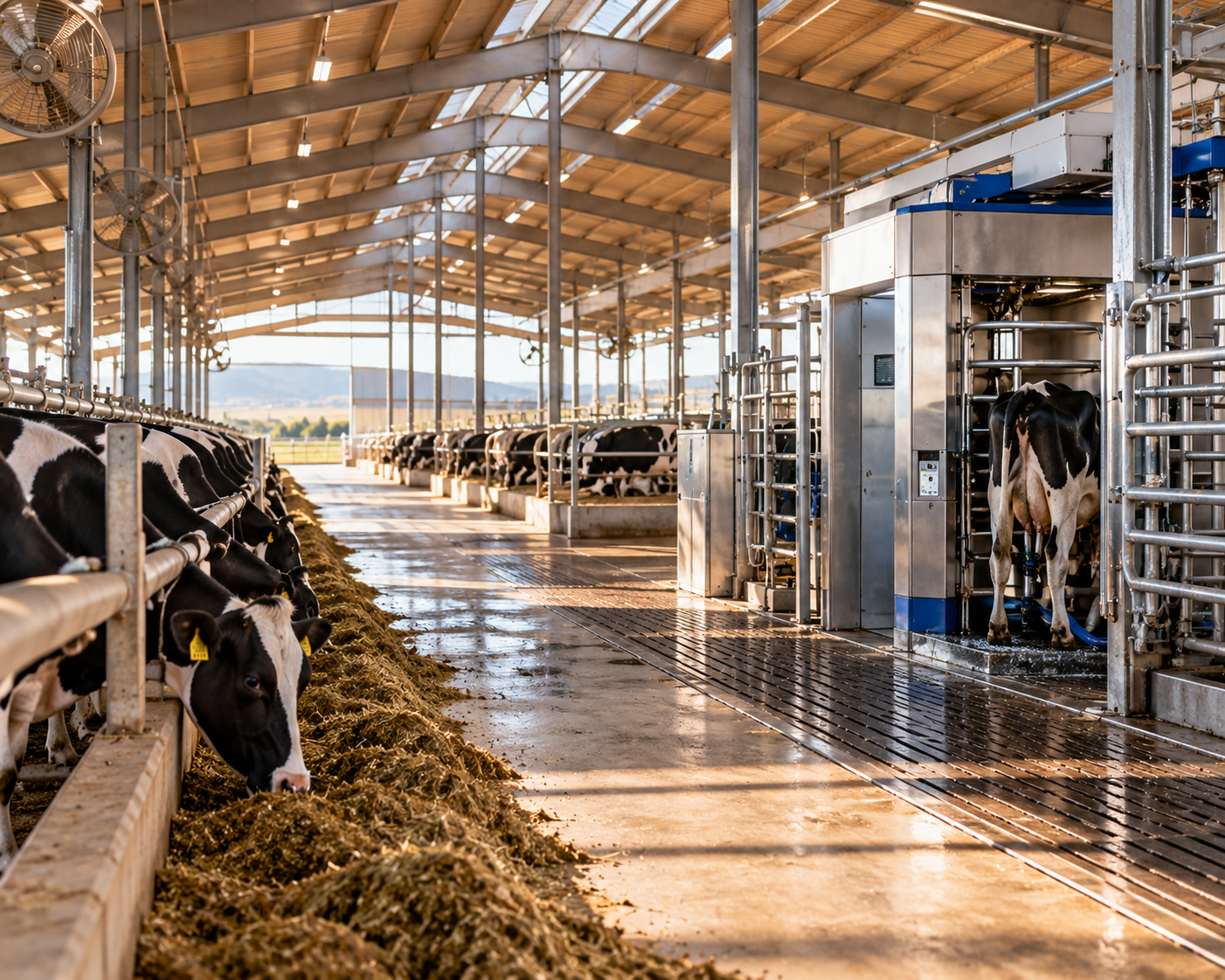
Most dairy farm insurance programs share a structural problem: they were built around physical damage to physical property, not the financial reality of how a dairy operation actually loses money. It is the first week of February. Your milk check arrived three days ago, 22 percent lower than the check that came in December. The herd is healthy. The milking robots are running. But the Class III milk price dropped $3.40 per hundredweight between November and January, and nothing in your insurance program responded. Nothing ever does.
This is the risk profile of a modern dairy operation. Revenue fluctuates by the month. Animal values sit in the millions. Specialized equipment runs 24 hours a day. Environmental exposure comes with the property. And a standard farmowners policy was designed around physical damage to physical property, not the financial structure of how a dairy actually runs.
Captive insurance does not solve the milk price problem by itself. But it changes what you can cover, what you pay to cover it, and who keeps the money when the year goes well.
Why Dairy Is Different From Every Other Farm Operation
The U.S. dairy sector has consolidated steadily over the past two decades. The typical large commercial dairy operation today looks fundamentally different from the family dairies of a generation ago. According to the U.S. Department of Agriculture's (USDA's) Economic Research Service (ERS), the trend is consistent: fewer farms, more milk per operation, and significantly higher capital investment per cow.[1]
A 2,500-cow Holstein dairy in the San Joaquin Valley or the upper Midwest might carry:
- Herd value: 2,500 Holstein cows at $2,800 per head is $7 million in animal assets — before you count the land, the buildings, or the equipment
- Milking system: a large automated parlor or 35 robotic milking units running 24 hours a day, with each unit representing $150,000 to $200,000 in specialized capital
- Milking infrastructure: freestall barns, cooling systems, bulk tanks, and manure handling equipment running $3 million to $6 million or more
- Feed inventory: a 90-day corn silage and hay supply easily exceeding $1 million on a herd this size
That is a capital-intensive operation with revenue that reprices every month. It also carries risk exposures that most standard policies were not built to handle at this scale.
What Your Standard Policy Actually Covers (And Where It Stops)
A standard farmowners policy covers physical damage. Fire destroys the freestall barn, wind takes the roof off the parlor, a covered peril destroys the feed storage: the policy responds. That coverage is real and necessary.
What a standard farmowners policy does not cover, or covers inadequately:
Animal mortality at replacement value. Here is a simple example. Fifty cows die in a disease event. At $2,800 per head, that is $140,000 in losses. A standard livestock mortality endorsement might cap at $500 to $1,000 per animal — meaning the policy pays $25,000 to $50,000 while you absorb the rest. On a herd of 2,500 cows, a disease event that moves through even 3 percent of your animals is a six-figure loss before the endorsement shortfall.
Milking equipment failure without physical damage. A section of your automated milking system goes down due to a software fault — no broken parts, no physical damage, just a system that stopped working. Standard equipment breakdown coverage pays for repairs. It does not pay for the milk 2,500 cows did not produce while the system was offline. At $20 per hundredweight (cwt) and 80 pounds per cow per day, two weeks of lost production from 2,500 cows is roughly $560,000 in unrecovered milk revenue. The equipment never broke. The commercial market has no product for that loss.
Environmental liability for concentrated animal feeding operations. A manure lagoon failure, a spill into a neighboring waterway, or contamination from per- and polyfluoroalkyl substances (PFAS) in irrigation water or biosolids applied to fields can trigger regulatory fines, remediation costs, and class-action liability. Dairy farms in multiple states have faced PFAS contamination events that quarantined their milk and triggered lawsuits. Here is the part your broker may not have told you: most standard commercial general liability and farmowners policies now exclude PFAS claims entirely. The Insurance Services Office (ISO) — the industry body that drafts the standardized policy forms most carriers license — introduced PFAS exclusion endorsements in 2022, and most carriers adopted them across their book. If your operation has PFAS exposure from irrigation water, biosolids, or nearby industrial sources, your standard policy does not cover it. The environmental liability in a standard policy was not designed for the scale of a concentrated animal feeding operation (CAFO) and almost certainly does not address your actual exposure.
The Volatility Problem That Insurance Rarely Solves
The federal Dairy Margin Coverage (DMC) program compensates dairy producers when the margin between milk prices and feed costs falls below the selected coverage level. In 2023, falling milk prices triggered record DMC payments to producers across the country.[2]
DMC is a partial solution. It covers the gap between milk price and feed costs up to the level a producer selects. It does not address the full economic loss when prices fall sharply, and it does not respond to individual farm circumstances: a spike in veterinary costs, a herd health event that cuts production, or a bad quarter driven by local factors.
Commercial property and casualty insurance does not address revenue volatility at all. Your farmowners policy does not know or care that you are running on a 4 percent margin this quarter instead of 11. That is not what it was designed for.
The gap between what federal programs cover and what actually lands on a dairy operation's books is where captive insurance can operate.
What a Captive Covers That a Carrier Won't Touch
A captive insurance company is an insurance company you own. It writes policies designed around what your operation actually does. For a dairy, that opens coverage options that the standard market either prices out of reach or does not offer at all.
Animal mortality at realistic replacement values. Your captive writes an animal mortality policy structured around your actual herd value: peak-production Holsteins, registered genetics stock, animals mid-cycle in their production life. You set the limits based on what your operation actually has at risk. No endorsement cap. No per-head ceiling that leaves you holding a six-figure loss.
Environmental liability for CAFO exposure, including PFAS. Your captive writes a policy that addresses the specific environmental exposure profile of your operation: manure storage capacity, proximity to waterways, PFAS contamination risk from irrigation or applied biosolids, and regulatory compliance history. A generic environmental endorsement may exclude the precise scenarios you are most exposed to. A policy built for your captive does not have to.
Equipment breakdown consequences — coverage that does not exist anywhere else. When a section of your milking system goes down due to a software fault and you lose $560,000 in milk revenue, no commercial carrier has a product that pays that loss. A captive can write that policy. This is one of the most powerful advantages of the structure, and it is only available through a captive. You cannot buy it any other way.
Coverage for risks the commercial market does not insure at all. Two examples that come up on almost every large dairy. First: an antibiotic-contaminated milk load. One animal treated with penicillin, milk from that cow reaches the bulk tank, and the entire load is condemned. On a large operation, a single load rejection can run $30,000 to $60,000 in dumped milk. Standard farmowners and dairy policies do not cover contaminated load losses — the commercial market has no product for it. Second: refrigeration or bulk tank failure resulting in spoiled milk. Equipment breakdown coverage pays to fix the equipment. It does not pay for the milk that spoiled while the tank was down. A captive can write policies for both. If a risk exists on your operation and no carrier will write it, your captive can.
The Risk Pool Advantage
A captive is not self-insurance. This distinction matters more in dairy than in almost any other agricultural operation, because the losses can be large and fast.
When your captive joins a risk pool alongside other well-managed dairy operations, you have genuine risk-sharing. When your operation has a covered loss, your captive pays a portion and the pool, funded by the other captives in it, pays the rest. In a 50/50 pool structure, half of every covered loss is borne by the pool. You are not absorbing 100 cents of every dollar.
When claims come in below what you contributed for the year, the surplus stays in your captive. It does not go to the pool's general fund. A commercial carrier keeps that money. Your captive keeps it for you.
Here is what that actually means. You own the captive. You own the captive's profits. The premiums your operation pays into the captive are invested, and the income from that investment is yours. When the year goes well and claims come in low, that money does not disappear into a commercial carrier's balance sheet. It stays in a company your family owns. It is your asset.
Commercial carriers have operated this way for a long time. They collect premiums, invest the float, keep the underwriting profit, and return nothing to the businesses that funded them. A captive gives that structure back to the operation running it.
Does Your Dairy Operation Qualify?
The general threshold for a captive to make financial sense is $250,000 or more in annual commercial insurance premiums. For a large dairy, that number includes property, general liability, and specialty lines: livestock mortality, environmental, equipment breakdown, and umbrella. A dairy operation running 1,000 or more milking cows, with the land, barns, equipment, and herd value that comes with it, almost always exceeds that threshold. An operation running 3,000 milking cows typically exceeds it several times over.
The right way to find out is a coverage review: a look at what you are currently paying, what those policies actually cover, and where the gaps are. That analysis is where the case for a captive either becomes obvious or does not.
Start With a Coverage Review
The risks that matter most to a dairy operation are not the ones your standard policy was designed for. You know this if you have ever read the exclusions in your farmowners policy against the actual list of things that keep you up at night.
A no-cost coverage review from 3F Captive Services looks at your current program: what you are paying, what it covers, and what it leaves exposed. If a captive makes sense for your operation, we will tell you what that structure looks like. If it does not, we will tell you that too.
Reach out to start the conversation.
Discover Tailored Insurance Solutions
Unlock the potential of customized captive insurance designed specifically for your unique business needs.