
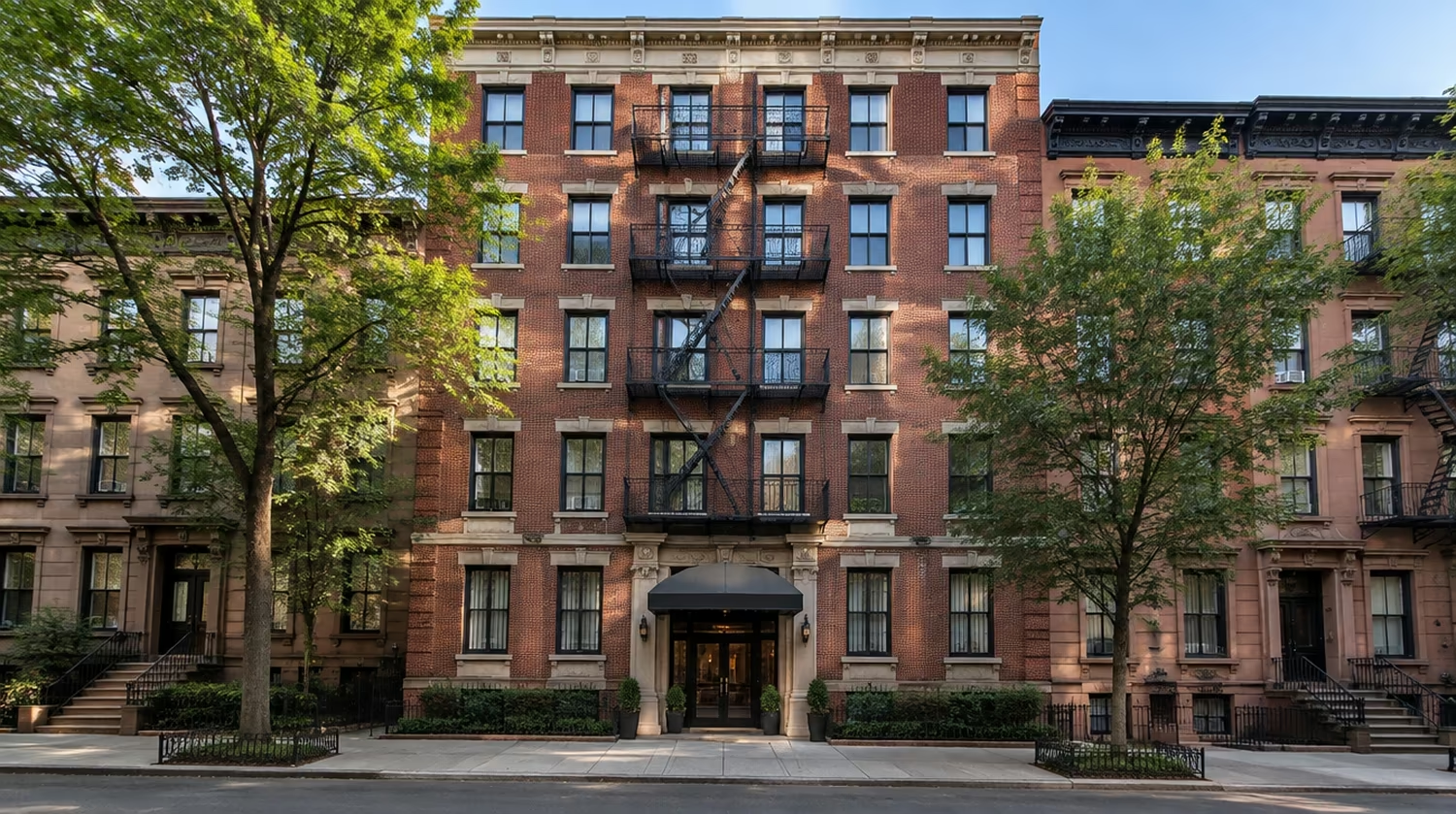
Between 2021 and 2024, liability claims per unit against New York City rental buildings rose nearly 70%.[1] Claims have stayed near that level since. If you own or manage rental property, the question isn't whether the cost of claims eventually reaches your budget. It's whether your insurance program was built for it.
Higher claims don't stay in the legal department. They show up as premium increases. In New York's affordable housing sector, those increases averaged about 21% a year from 2019 to 2023.[2] Those increases hit the bottom line directly — they come out of profits. And when margins get tight, the first things to go are repairs, maintenance, and new units.
If a serious premises claim landed tomorrow, would your coverage respond? And do you know what you're currently paying for risk you've never had?
What the Research Found
In September 2026, Milford Street Captive Insurance published the results of a joint analysis conducted by LegalClaimsAI and the New York University (NYU) Furman Center. Researchers matched data on 21,992 claims filed against 18,745 unique residential rental buildings covering 916,207 units — all filed in New York City between 2021 and 2025.[1]
Total claims grew about 30% in 2022 and another 30% in 2023, then leveled off and held at that elevated level.[1] On a per-unit basis, the rate climbed nearly 70% between 2021 and 2024 before easing slightly in 2025.[1]
The largest category was premises claims — slip-and-falls, building conditions, and maintenance-related injuries. Subsidized, income-restricted, and heavily rent-stabilized buildings faced consistently higher per-unit claim rates than market-rate properties across every year in the study.[1]
One more data point: New York State has more than 1.1 million active claims — Milford Street calls it the most litigious state in the country.[1] If you own property somewhere less litigious, read this as a leading indicator, not a local problem. These trends travel. Nationally, Gallagher reports U.S. general liability pricing for real estate still rising 4% to 9%, with excess liability under more pressure.[5]
You're Paying for Someone Else's Claims
Here is the structural problem: your premiums are priced on market-wide litigation trends, not on your portfolio's actual performance. If your buildings run documented inspections, resolve maintenance requests before they become injuries, and respond to incidents quickly, your claims record reflects that discipline. Your premium does not.
Carriers and pools see a market. They price to the average. So the well-managed portfolio subsidizes the poorly managed one, year after year, through the same renewal cycle.
By forming a captive, your good buildings stop paying for everyone else's bad ones.
New York's affordable housing industry did the math on this. Members formed Milford Street Captive Insurance Company — an industry-owned captive — to take control of their own risk.[3] New York State responded by making a $2 million loan to Milford Street to expand membership.[2] The City of New York went further: Mayor Zohran Kwame Mamdani announced a plan to invest $100 million in a city-backed insurance program for affordable housing providers, with a goal of covering 20,000 homes in the first year and 100,000 by 2030, with a target of cutting premiums by at least 20%.[2][4] What all of this means: the problem is real enough that both state and city governments have put money behind solving it. When public institutions start building their own insurance programs, that's a sign the commercial market isn't pricing this risk fairly.
When the commercial market prices an industry out of fair coverage, disciplined operators look for ways to own part of the risk. The levers are straightforward. Strong maintenance and inspection practices reduce premises claims at the source. A captive lets owners keep the financial benefit of those practices instead of handing it to the market or to an outside insurance company.
As John Crotty of Milford Street put it: "Unchecked litigation is an existential threat to affordable housing."[1] The operators who took that seriously didn't wait for carriers to fix the problem.
What a Captive Is — and What It Isn't
A captive is an insurance company you own. It issues policies to your business, holds the premium, and pays covered claims. It operates alongside your commercial program — it does not replace it. Your commercial coverage stays in place. Your broker keeps the book. The captive adds a layer most brokers can't offer on their own.
When a claim comes in, the captive helps pay it — not dollar for dollar. Because a well-structured captive participates in a risk pool alongside other similar captives, the loss is shared. In a 50/50 pool, half the loss comes from your captive and half comes from the pool. That is genuine risk-sharing, the same protection any insurance arrangement provides. When claims come in below what you contributed, the surplus stays in your captive, not a pool account. A properly structured captive may also carry tax advantages, but only when it is built around real risk, with premiums set at arm's length and properly disclosed on tax filings.
For property owners, coverage can be tailored broadly. Because 3F builds each captive's policies specifically for that owner, the program reflects what that portfolio actually does and what it is actually exposed to. Premiums are set at arm's length, based on actuarial analysis of that portfolio's actual risk. A captive can cover the deductibles in your traditional policies, the gaps in your commercial program, the layers above where your current coverage stops paying, and exposures the standard market prices poorly. It can also write policies for risks that have no commercial equivalent — coverage that simply does not exist in the standard market. You are not buying into a pre-packaged program designed for the average landlord. The program is designed by you and for you.
3F Captive Services handles formation, licensing, compliance, reporting, and claims administration end to end. Your property operations don't change.
Captives are licensed, regulated insurance entities. They are used across industries when the commercial market stops pricing individual risk fairly. New York's housing sector is a current and well-documented example, now backed by both state and city financing.
Do You Clear the Bar?
A captive makes financial sense when a portfolio's risk profile and premium volume can justify the structure. Here are the signals worth paying attention to:
- Your total insurance spend is $250,000 or more annually, across all lines. This is the general threshold for the structure to make financial sense.
- Your claims history has been favorable over the last five years. A captive rewards documented discipline. If your record reflects serious investment in safety and maintenance, it has value the market isn't giving you back.
- Your premiums are rising while your claims stay flat or trend down. This is the clearest sign you are subsidizing someone else's losses.
- You have had a claim denied or found a gap in coverage after the fact. If the policy didn't respond the way you expected, that gap is still there on the next claim.
- You run documented maintenance, inspection, and incident-response programs across your properties. This is what a captive prices. If you can document it, it has value.
- Your portfolio includes affordable, subsidized, or rent-stabilized units. The research confirms these buildings carry a higher rate of premises exposure. That concentration, when well-managed, is exactly what a captive is built for.
If most of these apply, the analysis is worth doing.
3F builds captives around real, documented risk and full regulatory compliance.
The Ask Is Small. The Information Is the Product.
You are not deciding whether to form a captive today. You are deciding whether to let someone read your policies.
Most portfolio owners have never had their coverage reviewed line by line in plain language. They have hundreds of pages across properties that govern exactly what happens when a claim lands. The gaps in those pages are real. Most owners find them the hard way.
3F Captive Services provides a no-cost coverage review. It goes through your existing program and surfaces:
- Coverage gaps
- Over-insured lines
- Premises exposures that are underinsured relative to your actual risk
- Red flags that could lead to a claim denial
- Where you are actually well covered
This is useful whether or not a captive turns out to be the right answer. Worst case, you learn what you actually bought.
The problem is claims and premiums rising faster than building performance. The answer is understanding what your program does — and deciding whether it should work harder for you.
No-cost analysis · 3fcaptiveservices.com/analysis
This article is general information, not legal, tax, or insurance advice.
[1] Insurance Journal, "Claims Against NYC Rental Buildings Nearly Doubled Since 2021: Milford Street," September 23, 2026. insurancejournal.com/news/east/2026/09/23/886248.htm
[2] Insurance Journal, "NYC Hires Pinnacle Actuaries, Seeks Private Partners for Housing Insurance Program," June 25, 2026. insurancejournal.com/news/east/2026/06/25/875223.htm
[3] New York Housing Conference, "Milford Street Insurance Company." thenyhc.org/projects/milford-street-insurance-company/
[4] Insurance Journal, "NYC Mayor Eyes Insurance Program for Affordable Housing," April 17, 2026. insurancejournal.com/news/east/2026/04/17/866400.htm
[5] Risk & Insurance, "Real Estate and Hospitality Property Rates Ease Globally While Casualty Markets Diverge by Region" (Gallagher August 2026 Real Estate & Hospitality Global Market Update), September 28, 2026. riskandinsurance.com/real-estate-and-hospitality-property-rates-ease-globally-for-while-casualty-markets-diverge-by-region/
Discover Tailored Insurance Solutions
Unlock the potential of customized captive insurance designed specifically for your unique business needs.