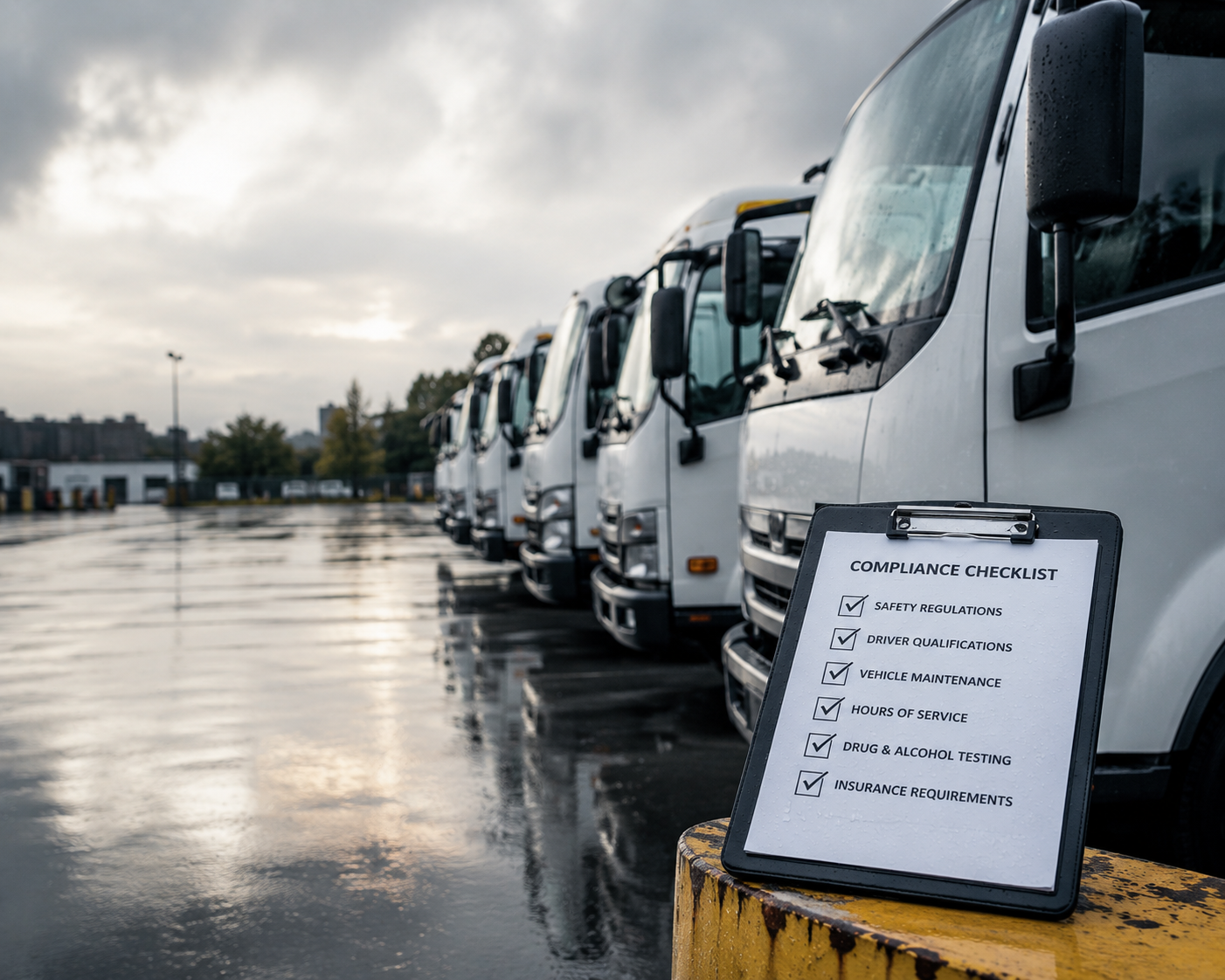
A Department of Transportation out-of-service order stops your trucks, halts your revenue, and triggers legal costs. Standard commercial policies cover almost none of it. Here is what the regulatory coverage gap looks like and what a captive can do.
What DOT and FMCSA Actually Regulate
The Department of Transportation, or DOT, is the federal agency with authority over commercial transportation in the United States. Within the DOT, the Federal Motor Carrier Safety Administration, or FMCSA, is the specific agency that regulates commercial motor carriers: the companies that operate trucks, buses, and other commercial vehicles in interstate commerce.
FMCSA's regulatory reach is broad and operationally specific. It covers hours of service — the federal rules limiting how many hours a driver can operate without rest. It mandates electronic logging devices to enforce those limits. It requires drug and alcohol testing programs for all drivers subject to commercial driver's license requirements. It sets minimum standards for driver qualification files, vehicle maintenance, and roadside inspections. And it assigns each motor carrier a safety rating — Satisfactory, Conditional, or Unsatisfactory — based on compliance data, inspection results, and crash history.
That safety rating is not an internal compliance metric. It is a public record, visible to every shipper, broker, and logistics partner a carrier works with. It affects the carrier's ability to get loads, maintain client relationships, and compete for contracts. A Conditional or Unsatisfactory rating is not just a regulatory problem. It is a business problem.
An FMCSA safety rating is public. Every broker, shipper, and logistics platform can see it. A downgrade does not stay inside the regulatory world. It follows the carrier into every commercial relationship.
The Out-of-Service Order Problem
FMCSA and its enforcement partners — state commercial vehicle enforcement agencies operating under the Commercial Vehicle Safety Alliance — have authority to place carriers and individual vehicles out of service. An out-of-service order can be issued at a roadside inspection, following an audit, or as a result of a compliance investigation.
A vehicle placed out of service cannot operate until the cited deficiency is corrected and an authorized inspector clears it. A carrier placed out of service cannot dispatch any regulated vehicles. The operational shutdown is immediate. There is no phase-in period and no grace period for revenue impact.
Standard commercial business interruption coverage requires a direct physical loss to property as the triggering event. A fire at the terminal, a flood that damages the fleet, a collision that destroys equipment — those are covered triggers. A federal regulatory order that halts operations without any physical damage to property is not. The revenue loss from an out-of-service order is real. The commercial policy does not respond.
Legal defense of an FMCSA enforcement action adds a second uninsured cost. Challenging an out-of-service determination, responding to a compliance review, or contesting a safety rating downgrade requires legal representation. Commercial general liability policies exclude regulatory defense. Commercial auto policies address vehicle-level claims, not agency enforcement actions against the carrier entity.
• Roadside out-of-service: Individual vehicle placed out of service at inspection. Driver cannot continue. Load may be delayed or transferred. Direct cost: repositioning, recovery, customer impact. Insurance response: none.
• Carrier-level out-of-service: Entire operation halted pending compliance resolution. All dispatched vehicles must stop. Revenue impact begins immediately. Legal defense required. Insurance response: none.
• Safety rating downgrade: Conditional or Unsatisfactory rating posted publicly. Brokers route loads elsewhere. Shipper contracts reviewed. Revenue impact is ongoing and not tied to a discrete covered event. Insurance response: none.
The Compliance Violation Cost Stack
FMCSA enforcement actions generate costs that stack on top of each other. Understanding the full cost of a significant compliance event requires looking at each layer.
Civil penalties. FMCSA has authority to impose civil monetary penalties for violations of federal motor carrier safety regulations. Penalties vary by violation category and can reach tens of thousands of dollars per violation. Hours-of-service violations, drug and alcohol testing failures, and driver qualification file deficiencies each carry their own penalty schedule. Commercial insurance policies universally exclude fines and penalties imposed by government agencies.
Enforcement defense costs. Responding to a compliance review, contesting a civil penalty assessment, or challenging an out-of-service determination requires legal counsel familiar with FMCSA practice. That is a specialized area. Hourly rates reflect the specialization. A contested compliance action that runs through the administrative hearing process can generate significant legal fees before any final determination.
Remediation costs. When a compliance review identifies deficiencies, the carrier must correct them. That may mean retraining drivers, updating recordkeeping systems, replacing equipment, or overhauling safety management programs. Those costs are operational expenses with no insurance coverage.
Revenue loss during shutdown. An out-of-service order that lasts days or weeks generates revenue loss that does not appear in any covered-loss calculation. Loads do not get delivered. Contracts may have service failure provisions. Customers may seek alternative carriers. Commercial business interruption will not pay it.
The Post-SCOTUS Dimension
In May 2026, the United States Supreme Court issued a unanimous ruling in Montgomery v. Caribe Transport II (No. 24-1238) holding that freight brokers can be held liable under state negligent hiring laws when they route loads to carriers with poor safety records. [1] The ruling fundamentally changed the risk calculus for every freight broker in the country.
Before the ruling, brokers operated under a broad assumption that federal law shielded them from state tort claims arising from carrier conduct. That assumption is gone. Brokers now face direct financial liability for the safety records of the carriers they hire. The practical result is that brokers have a strong financial incentive to route loads only to carriers with clean FMCSA safety histories, documented compliance programs, and current satisfactory ratings.
For a fleet carrier, a Conditional or Unsatisfactory FMCSA safety rating no longer just triggers a regulatory response. It triggers a commercial response. Brokers managing their own negligent hiring exposure will bypass the carrier. Load volume drops. Revenue drops. The regulatory event becomes a revenue event, and it happens faster and more severely than it did before May 2026.
Before the SCOTUS ruling, a safety rating downgrade cost you regulatory credibility. After it, the same downgrade costs you broker relationships. The financial exposure doubled without any change in the underlying regulation.
What Standard Commercial Policies Exclude
The coverage gaps in standard commercial transportation policies follow a consistent pattern across the regulatory compliance exposures described above.
• Fines and civil penalties: Universally excluded. No commercial property and casualty policy covers government-imposed fines, penalties, or assessments.
• Regulatory defense costs: Generally absent or sublimited. Commercial general liability policies cover defense of civil claims from third parties, not defense of regulatory enforcement actions by federal agencies.
• Business interruption from regulatory shutdown: Excluded. Standard business interruption requires a direct physical loss trigger. A federal out-of-service order does not qualify.
• Revenue loss from safety rating downgrade: Not a covered trigger under any standard commercial form. There is no policy designed to pay revenue losses caused by a public regulatory rating event.
• Remediation and compliance program costs: Operational expenses. No coverage.
The Captive Insurance Opportunity
A transportation captive insurance program can be structured to cover each of the regulatory compliance exposures that commercial policies exclude.
Regulatory defense coverage. The captive writes a policy that covers legal defense costs for FMCSA enforcement actions, compliance reviews, civil penalty proceedings, and out-of-service challenges. The trigger is a federal regulatory action against the carrier, not a third-party civil claim. This is coverage the commercial market does not provide.
Business interruption tied to regulatory shutdown. The captive defines the trigger as a federal or state out-of-service order that halts carrier operations. No physical loss required. Revenue loss during the shutdown period is a covered event. The policy pays what the commercial policy explicitly will not.
Safety rating event coverage. A captive can be structured to provide a defined revenue protection benefit triggered by a Conditional or Unsatisfactory FMCSA safety rating, covering a portion of documented revenue loss during the period the carrier is working to restore its rating. No commercial policy addresses this exposure.
Workers' compensation calibrated to the carrier's safety record. Carriers that invest in compliance programs, driver training, and hours-of-service management generate better workers' comp loss experience than the commercial pool average. In a captive, that outperformance builds reserve rather than carrier profit.
Under IRC Section 831(b), premiums paid to a qualifying captive are deductible by the parent company, and captive underwriting income accumulates tax-deferred. [2] The same safety and compliance investment that produces favorable regulatory outcomes also drives the loss experience that makes a captive economically compelling.
The regulatory exclusions in standard commercial policies are not oversights. Carriers have been absorbing these costs as operating expenses for decades. A captive converts them into a structured, covered exposure with a defined financial response.
Who Qualifies
Transportation operators spending $250,000 or more on combined workers' compensation, commercial auto, cargo, and liability coverage are in the range where a captive feasibility study generally demonstrates real economic value. In high-tax states, that threshold can be lower: the tax benefit of the 831(b) structure adds meaningfully to the economic case at premium levels where the loss-ratio arithmetic alone might not yet fully justify formation costs. That is a guideline, not a hard rule. Carriers with documented compliance programs and safety records that outperform their peer group are often the strongest candidates regardless of where total premium falls.
Regional carriers, dedicated fleet operators, and logistics companies with active FMCSA compliance programs are frequently well above that level when all coverage lines are combined.
Contact 3F Captive Services for a no-cost policy analysis. We identify the regulatory coverage gaps in your current program and model what a captive structure could cover for your specific operation.
⚠ This post is for informational purposes only and does not constitute insurance, legal, or tax advice. Regulatory requirements, penalty schedules, and coverage terms vary by jurisdiction, carrier type, and policy form. Consult qualified insurance, legal, and tax advisors regarding your specific situation.
Sources
[1] Montgomery v. Caribe Transport II, U.S. No. 24-1238 (May 14, 2026). Opinion by Justice Amy Coney Barrett. https://www.supremecourt.gov/opinions/25pdf/24-1238_1b7d.pdf
[2] Internal Revenue Code Section 831(b). Captive insurance company tax treatment for qualifying small insurance companies.
[3] Federal Motor Carrier Safety Administration (FMCSA). Safety Measurement System and carrier safety rating methodology. U.S. Department of Transportation. https://www.fmcsa.dot.gov
Discover Tailored Insurance Solutions
Unlock the potential of customized captive insurance designed specifically for your unique business needs.