
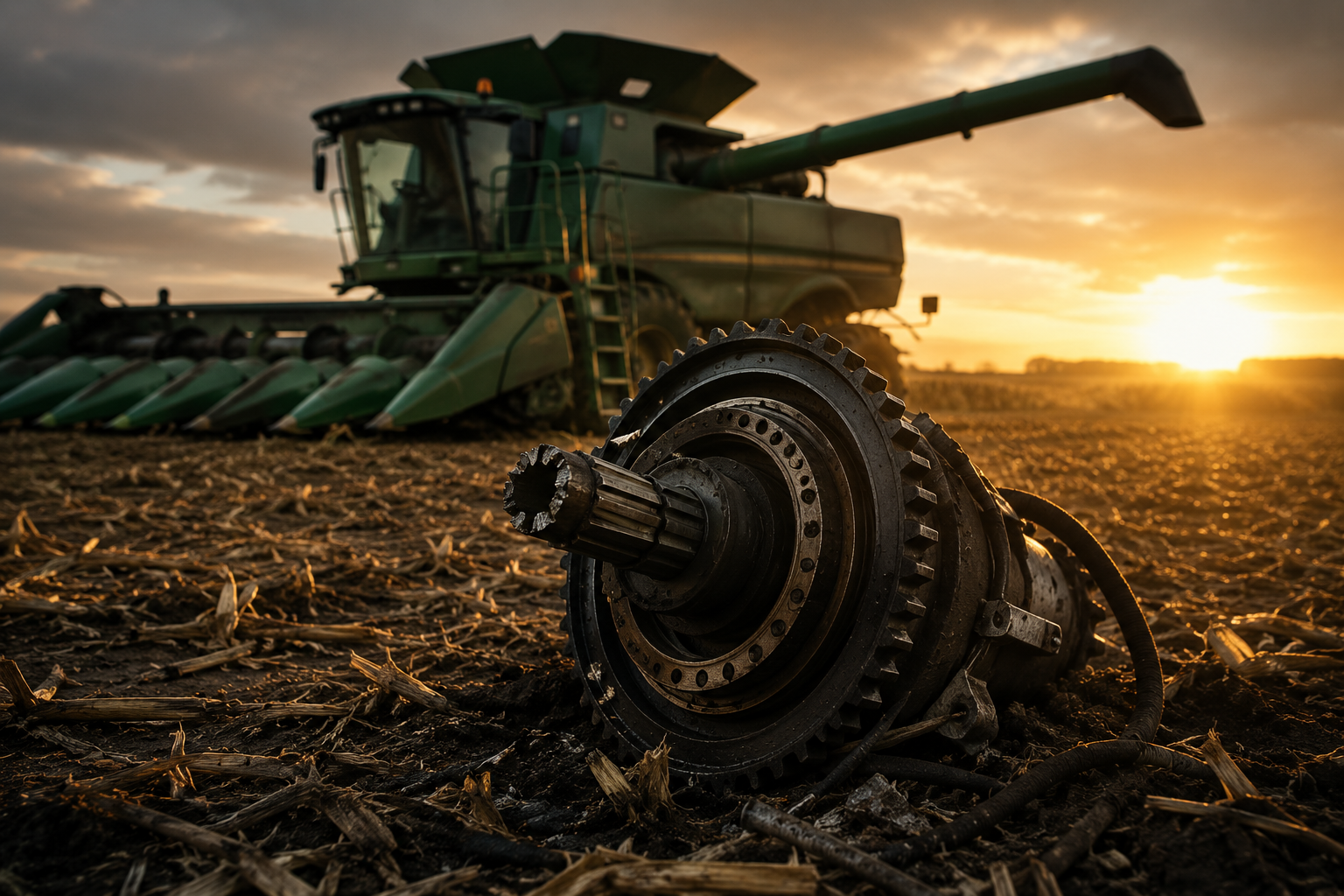
Modern farm equipment costs hundreds of thousands of dollars per unit. Standard farmowners policies were not designed to cover it. Here is what the gap looks like and what a captive can do.
The Equipment on Today's Farm
Modern agricultural operations depend on equipment that would have been unrecognizable to the previous generation of farmers. A GPS-guided combine today costs $400,000 to $700,000. A high-end row-crop tractor with precision auto-steer runs $150,000 to $500,000. Center-pivot irrigation systems covering a single field can cost $100,000 to $200,000 each. Add grain handling and drying equipment, planters, sprayers, and support vehicles, and a mid-size grain operation can carry $2 million to $5 million in equipment value on a single farm.
That equipment is the farm's production capacity. When it fails at the wrong moment, the consequences extend well beyond a repair bill.
Precision agriculture technology compounds the cost. GPS receivers, variable-rate application controllers, yield monitors, and telematics systems are now standard on commercial equipment. These components are expensive to source, often on allocation from manufacturers, and require dealer technicians with specialized training to diagnose and repair. Lead times that would have been measured in hours for older mechanical systems are now measured in weeks for precision electronics.
The Coverage Gap in Standard Farmowners Policies
Farmowners multi-peril policies remain the standard insurance structure for most agricultural operations. These policies carry a five-year average loss ratio of 70.50 percent, meaning carriers pay out roughly 70 cents per dollar collected across the combined farmowners book. [1] That ratio covers the entire farmowners policy: fire, liability, dwelling, and crop losses combined. Equipment breakdown is one piece of that bundle, and the payout rate on that specific coverage is not separately reported. The 49.50 percent loss ratio for inland marine and equipment coverage, discussed in the next section, is the more relevant benchmark for equipment-specific claims.
The critical issue is not the aggregate loss ratio. It is the sublimit structure. Equipment breakdown coverage in farmowners policies is frequently sublimited to figures that made sense when the policy was written but bear little relationship to today's replacement costs. A combine that cost $200,000 a decade ago costs $500,000 or more to replace today. A sublimit written at $250,000 ten years ago leaves a $250,000 gap at current prices.
Standard commercial policies also carry trigger language requiring that equipment failure be “sudden and accidental” to qualify for coverage. Gradual degradation of precision electronics, GPS receiver failure, or hydraulic system wear that develops over a season often falls outside that trigger. The carrier declines the claim; the farmer absorbs the loss.
The exclusions that allow commercial carriers to deny equipment breakdown claims and the sublimits that leave farms underinsured at today's replacement costs do not have to exist in a captive policy. The business writes the terms because the business owns the insurer.
The Harvest Timing Problem
The financial exposure most difficult to insure on a farm is not equipment replacement cost. It is harvest timing.
Corn, soybeans, and wheat have harvest windows measured in days. Corn at peak moisture for optimal yield has roughly a 10 to 14 day window before quality declines and market price drops. A combine breakdown on day three of that window, with parts on a two-week lead time from the manufacturer, does not just cost a repair bill. It costs the harvest.
Standard business interruption coverage requires a “direct physical loss” as the triggering event. Equipment breakdown that halts harvest operations, without associated structural or property damage, frequently does not qualify as a covered trigger under a commercial policy. The farm loses income; the policy does not respond.
This is one of the most consistent coverage gaps in agricultural insurance, and it is rarely visible to the farmer until a claim is filed and denied. By that point, the harvest window has closed, and the loss comes off the farm's top line revenue.
• A combine breakdown during peak corn harvest with a two-week parts lead time: harvest window closes, income loss is real, and standard business interruption coverage does not pay.
• A center-pivot irrigation system failure during a heat event: crop damage from the failure may not trigger a covered peril under a standard farmowners form.
• GPS receiver failure on a planter during a narrow planting window: delayed planting affects yield; commercial policies rarely address this exposure at all.
What the Loss Data Shows
A note on terminology: inland marine is an insurance industry classification that sounds like it should apply only to boats and waterways. It does not. The term originated with coverage for goods transported by water, then expanded over a century to cover goods shipped overland, and today includes virtually any movable property or equipment. For agricultural operations, it is the coverage category that includes farm machinery, equipment floaters, and machinery breakdown policies.
The five-year loss ratio for inland marine and equipment coverage is 49.50 percent nationally. [1] Carriers are collecting roughly two dollars for every dollar paid in claims on this book. That ratio is among the lowest of any major commercial line, meaning equipment coverage is one of the most profitable segments of the market for carriers.
For context, the overall five-year loss ratio across all property and casualty (P&C) lines averaged 63.39 percent over the same period. Equipment coverage runs roughly 14 points below that average, reflecting a line where carriers have historically written restrictive policy forms, maintained aggressive sublimits, and relied on trigger language that limits claim exposure.
Workers' compensation for agricultural operations compounds the picture. Farm labor is classified among the higher-risk occupational categories nationally, yet the workers' comp loss ratio averaged 49.72 percent across all lines over the same period. [1] Well-run farm operations with strong safety programs are consistently subsidizing less disciplined operations in the commercial pool.
The Captive Insurance Opportunity
An agricultural captive insurance company can be structured to cover what standard farmowners policies consistently exclude.
Equipment breakdown at actual replacement value. The policy is written to reflect what a combine costs today, not what it cost when the farmowners form was last updated. Sublimits are set by the business, based on current equipment schedules, not by a carrier using industry-average pricing from prior years.
Business interruption tied to harvest-window production loss. A captive can define the trigger as equipment-caused production loss during a specified harvest period and pay on that basis, without requiring a direct physical loss to real property. This is the gap that commercial policies most consistently fail to cover on working farms.
Workers' compensation calibrated to the operation's actual loss history. The five-year workers' comp loss ratio of 49.72 percent means well-run farm operations have been consistently overpaying into a commercial pool they outperform. In a captive, that outperformance builds the farm's own reserve rather than the carrier's profit.
Specialty crop and input cost coverage. Captive policies can be written to address exposures that standard farmowners forms sublimit or exclude entirely, including coverage for high-value specialty crops, purchased seed and chemical inventory, and equipment-related input losses that fall outside standard crop insurance programs.
Under IRC Section 831(b), premiums paid to a qualifying captive are deductible by the parent company, and captive underwriting income accumulates tax-deferred. [2] That structure allows a farm operation to build a reserve against the risks that commercial carriers consistently underpay, while receiving the same tax treatment that commercial premiums provide.
Who Qualifies
Agricultural operations spending $300,000 or more on combined equipment, workers' compensation, property, and specialty crop coverage are in the range where a captive feasibility study generally demonstrates real economic value. In high-tax states, that threshold can be lower: the tax benefit of the 831(b) structure adds meaningfully to the economic case at premium levels where the loss-ratio arithmetic alone might not yet fully justify formation costs. That is a guideline, not a hard rule. Operations with significant equipment breakdown or harvest-season business interruption exposure may qualify at lower premium levels, given the severity of the coverage gaps the commercial market consistently fails to address.
Multi-location grain operations, large-scale specialty crop growers, vertically integrated agribusiness operations, and farms with significant precision equipment concentrations are frequently well above that level when all coverage lines are combined.
Contact 3F Captive Services for a no-cost policy analysis. We identify the coverage gaps in your current program and model what a captive structure could cover for your specific operation.
⚠ This post is for informational purposes only and does not constitute insurance, legal, or tax advice. Equipment costs, loss ratios, and coverage terms vary by carrier, policy form, and operation. Consult qualified insurance and tax advisors regarding your specific situation.
Sources
[1] Shearer, Brian. "Regulating Insurance as a Public Utility." Forthcoming, Columbia Business Law Review (April 2026). Inland marine/equipment loss ratio, farmowners multi-peril loss ratio, workers' comp loss ratio: Figure 2, pp. 44-45. NAIC 2024 Market Share Reports.
[2] Internal Revenue Code Section 831(b). Captive insurance company tax treatment for qualifying small insurance companies.
Discover Tailored Insurance Solutions
Unlock the potential of customized captive insurance designed specifically for your unique business needs.