
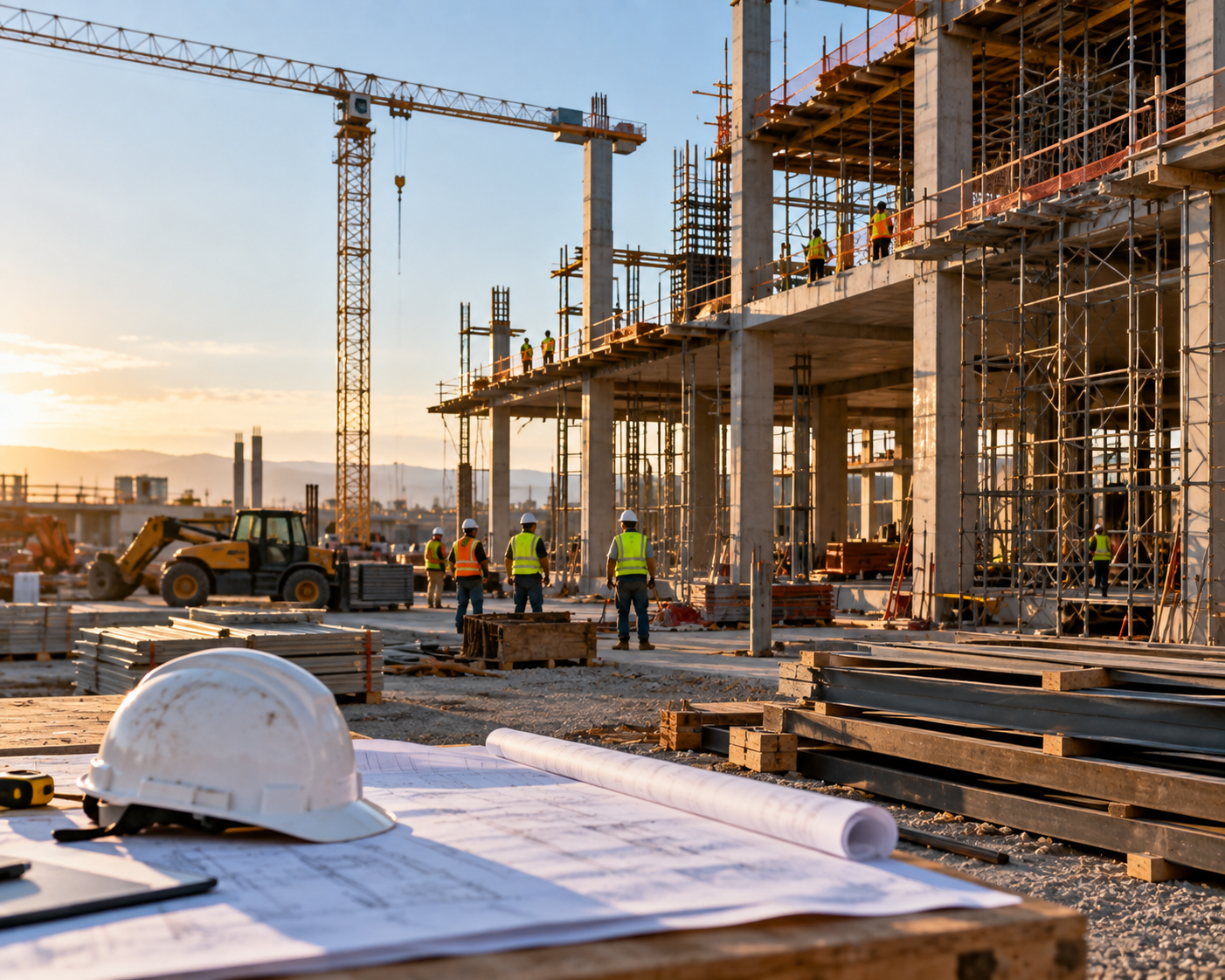
Builder's risk coverage gaps tend to stay invisible right up until a project goes sideways. You paid for the coverage. The project hit a delay. Costs piled up. Then someone read the policy closely and found the cap on what they would actually pay. That is when the gaps stop being theoretical, and when you start asking why nobody mentioned them at signing.
Builder's risk insurance is one of the most misunderstood policies in commercial construction. It sounds comprehensive. The name implies protection from the ground up. But every general contractor who has fought a soft cost claim or tried to recover delay losses knows the feeling: the policy was written for what the carrier wanted to cover, not for what the project actually needed.
Captive insurance does not just fill those gaps. It restructures who is running the risk and who is keeping the profit from managing it well.
What Builder's Risk Actually Covers (and What It Does Not Say Out Loud)
A standard builder's risk policy covers physical loss or damage to the structure under construction from named perils, typically fire, wind, vandalism, and certain water damage. It covers materials on-site, sometimes in transit, and often extends to temporary structures and scaffolding. It runs from groundbreaking until the project is finished.
That is a reasonable description of the coverage, and it is also a description of its limits. The policy covers the physical structure. It does not automatically cover what happens to your business when the physical structure is not finished on time, or what happens after the structure is finished and something goes wrong with the work.
Builder's risk ends when the project is finished. Everything that happens after, the leak that shows up in year two, the structural issue traced back to a foundation pour, the mechanical failure six months after move-in, falls outside the policy entirely.
That is not a surprise to experienced contractors. What is sometimes a surprise is how many of the common large-project exposures fall into the gaps even before completion.
The Gaps That Show Up When It Matters Most
On a straightforward residential project, the standard form probably works fine. On a large commercial project, four gaps consistently create problems.
- Soft costs and delay in opening. When a project is delayed, the costs do not stop. Architect and engineering fees continue. Construction financing accrues interest on undrawn funds. Permits expire and must be reapplied for. Marketing costs are sunk. If the project is income-producing, rental revenue is delayed. Standard builder's risk policies either exclude these costs entirely or cap them well below what you actually lose. A $200,000 cap on a $15 million project with $40 million in expected first-year rental income is not meaningful coverage.[1]
- Claims that arise after the project is done. Builder's risk ends when construction finishes. A separate general liability (GL) policy covers claims that come in after the work is complete, but it carves out faulty workmanship. What counts as faulty workmanship versus covered property damage varies by state and by policy, and these disputes drag on. Contractors who do large commercial work often carry long-term liability for it, and the coverage that's supposed to protect them in the years after turnover has more holes than most realize.
- Code upgrade costs after a loss. When a fire or major loss triggers a rebuild, current building codes apply to the new construction. If the original building was permitted under older codes, the cost of bringing the rebuild into compliance can be substantial. Policies cap this coverage, often at levels that do not reflect what code upgrades actually cost today.[2]
- Design errors and professional liability. If a project delay or loss traces back to an error in the design documents, builder's risk does not respond. That is a professional liability claim against the architect or engineer. The contractor is often caught in the middle, absorbing costs while litigation between the owner, architect, and their respective insurers plays out over years.
None of these gaps are secrets. Every experienced contractor and risk manager knows they exist. The standard response is to buy endorsements, standalone policies, or higher limits where available. The problem is that commercial carriers price those endorsements for the contractors who have had problems, not for the ones who have not.
Why Commercial Builder's Risk Is Priced for Someone Else's Project
Commercial insurance markets pool risk across a population of insureds. That is the core function of insurance and also the core problem for a well-run construction company.
Builder's risk and construction liability rates are set based on claims history across the whole book, project type, geography, and contract size. The general contractor who pre-qualifies every subcontractor, maintains active safety management on every site, and has a ten-year claims record well below industry average is priced in the same market as the contractor who bid the cheapest sub available and has had three significant losses in five years.
The carrier does not know who you are. It knows what the category your type of work falls into looks like on average, and it prices to that average. Your good years earn you a discount at renewal. They do not get rewarded the way a captive rewards them.
Over five years, a commercial contractor with $480,000 in annual premiums across general liability, builder's risk, equipment, and umbrella, averaging $85,000 in annual losses, transfers roughly $1.975 million in profit to the carrier. The carrier earns investment income on your premium dollars while they sit in reserve waiting for a claim. When the contractor's renewal comes back, the pricing reflects the market, not the contractor's actual performance.
That is not a complaint about the insurance industry. That is how pooled pricing works. But it is a very good description of why a captive exists.
How a Captive Fills the Gaps Without Buying Every Rider
A captive insurance company is owned by the contractor. Premiums flow into the captive. Claims are paid from captive reserves. When the captive collects more than it pays, the surplus stays with the owner.
For a construction company, the captive creates specific structural advantages in the areas where standard builder's risk falls short:
- Soft cost coverage at meaningful limits. The captive can write delay and soft cost coverage calibrated to actual project revenue exposure, not to whatever cap the commercial market is willing to sell. For a company doing $40 million in commercial development annually, a captive can carry $2 million in soft cost coverage per project at a premium that reflects the contractor's own delay history, not the market's.
- Coverage for claims after the project is done. A captive can extend post-completion coverage at limits and terms that reflect the contractor's actual history. For a general contractor with fifteen years and no significant post-completion losses, the captive premium for that coverage is dramatically lower than what the commercial market charges.
- Code upgrade costs at current levels. The captive can carry code upgrade coverage at limits tied to current cost estimates for the contractor's project portfolio, updated as codes change, without waiting for a commercial renewal cycle to catch up.
- Coordinated program design. Rather than buying separate endorsements and standalone policies from multiple carriers, the captive serves as the coordinating layer. The contractor controls coverage terms, limits, and deductibles across lines in a single integrated structure.
The Reserve Advantage: Running the Same Playbook the Carriers Do
Insurance companies are not mysterious businesses. They collect premiums. They invest those premiums and earn returns on the float between collection and claim payment. When their underwriting is disciplined, claims paid are less than premiums and investment income combined. That spread is how carriers have generated outsized returns for over a century.
A captive puts the contractor on the same side of that equation.
Here is what makes it more powerful than simply buying better commercial coverage: traditional carriers cannot screen their insureds the way a captive owner can. They have to accept the broad construction market, which includes contractors with poor sub pre-qualification, weak site safety, and inconsistent project controls. They build the cost of those worse risks into everyone's premium. Good contractors subsidize bad ones by design.
A captive owner does not have to subsidize anyone else's bad projects. The captive insures exactly one risk: the contractor's own well-managed business. The profit a commercial carrier earns from a disciplined contractor's clean claims history stays with the carrier in a commercial arrangement. In a captive, it stays with the contractor.
Consider the math on a five-year program: a commercial GC with $480,000 in annual premiums and $85,000 in average annual losses generates roughly $280,000 per year in net reserve accumulation after captive operating expenses. At a 4.5 percent return on invested reserves, the captive generates approximately $135,000 in cumulative investment income over five years. The reserve balance at year five approaches $1.5 million.[3]
When a major delay claim arrives on a $22 million office project, $380,000 in financing costs, extended overhead, and permit reapplication fees, the captive has the reserve to cover it. The commercial policy's $200,000 cap would have left $180,000 uncovered. The renewal penalty would have shown up regardless.
The carrier kept the float on five years of premiums. The captive owner kept both the float and the underwriting profit.
Does Your Company Qualify?
Captive structures work best for construction companies generating enough premium volume to make the economics of captive ownership work. The general threshold is $250,000 or more in total annual insurance premiums across all lines, including general liability, builder's risk, workers' compensation, equipment, and umbrella.
Companies with strong, documented claims histories relative to their peers are the strongest candidates. The captive captures the value of that performance rather than distributing it to a pool. Companies with significant exposure to delay costs, post-completion claims, or code upgrade requirements in areas where commercial coverage caps consistently fall short benefit most from the flexibility a captive provides.
Start with a Coverage Review
Most construction companies that qualify for a captive have never mapped their actual project exposure against their current coverage limits. The gaps between what you are actually exposed to on a large project and what your current policies would pay are often larger than expected, particularly around delay costs, post-completion claims, and code upgrade requirements.
3F Captive Services provides a no-cost coverage review that goes through your existing policies, identifies the gaps and exclusions in your current program, and shows how a captive structure can address what the commercial market is leaving uncovered. This coverage review is how you find out whether it is worth doing.
Your loss history is an asset. The question is whether you are the one keeping its value.
No-cost coverage review. No obligation. Contact 3F Captive Services at 3fcaptiveservices.com.
This post is for informational purposes only and does not constitute insurance, legal, or tax advice. Captive insurance structures involve complex regulatory and tax considerations. Consult qualified insurance, legal, and tax advisors regarding your specific situation.
Sources
1. Travelers Insurance. Builder's Risk Coverage: Understanding Soft Costs and Delay in Opening Provisions, 2024. Overview of soft cost sublimit structures, common exclusions, and delay in opening coverage mechanics in commercial builder's risk policies. travelers.com.
2. International Risk Management Institute (IRMI). Ordinance or Law Coverage in Construction: Gaps, Sublimits, and Market Practice, 2025. Analysis of ordinance or law sublimit adequacy relative to current code upgrade costs across major U.S. construction markets. irmi.com.
3. Captive Insurance Companies Association (CICA). Captive Reserve Investment Practices and Returns, 2024. Survey and analysis of investment strategies, return benchmarks, and reserve management practices among single-parent captive structures. cicaworld.com.
Discover Tailored Insurance Solutions
Unlock the potential of customized captive insurance designed specifically for your unique business needs.