
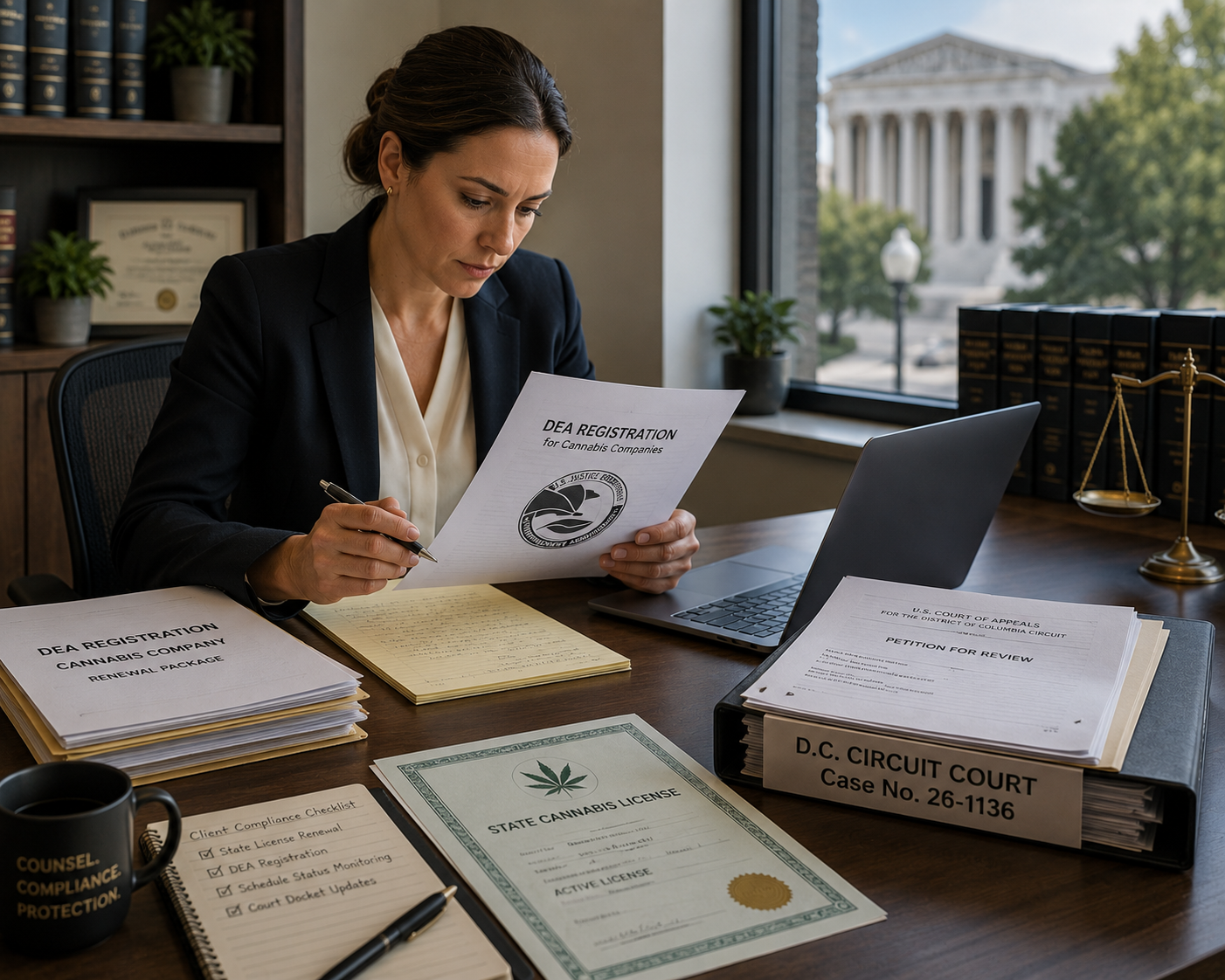
Every cannabis attorney has been tracking the DEA hearing. Fewer are tracking what changed underneath DEA registration for cannabis companies, or the case that could undo the DOJ's April order entirely.
What Attorneys Have Been Watching, and What They're Missing
The DEA's rescheduling hearing concluded July 15 after weeks of testimony, and post-hearing briefs are due August 17. That process determines whether the rest of the cannabis market, adult-use product, the plant in bulk, everything still sitting in Schedule I, eventually moves to Schedule III too. It's a real process worth tracking, and it's also not the one most likely to change a client's legal position in the next 90 days.
The Case That Could Undo the Spring's Progress
That distinction belongs to a separate case at the D.C. Circuit Court of Appeals, docket 26-1136, challenging the DOJ's April 2026 order that already moved state-licensed medical cannabis to Schedule III. Petitioners include a physician drug-testing trade association and a pharmaceutical company pursuing FDA approval for a competing cannabis-derived drug. Their argument: the Attorney General exceeded the authority Congress gave him under 21 U.S.C. § 811(d)(1), and the order's substantive regulations should have gone through notice-and-comment rulemaking under the Administrative Procedure Act instead of being issued by order.
The court hasn't reached the merits yet. It's deciding threshold questions first: whether either petitioner has standing, and whether the order should be stayed while the case proceeds. Practitioners following the briefing expect a ruling on those threshold questions within weeks, and if the court grants both standing and a stay, medical cannabis's Schedule III status could be paused while the litigation continues.
For a client who obtained DEA registration or restructured a license on the assumption that Schedule III status was settled, a stay would not be an abstract legal development. It would be a live question about which schedule their product sits in.
The Registration Dependency Most Clients Don't Realize They Have
There's a technical dependency worth flagging to every medical-license client regardless of how the D.C. Circuit rules. The April order conditions federal handling of medical cannabis on DEA registration, and makes that registration explicitly subordinate to the underlying state license: if the state license lapses, the DEA registration is automatically suspended. Some cannabis tax counsel treat having that registration in hand as a practical prerequisite to relying on Schedule III treatment at all, even though the order's text ties the tax and scheduling consequence to the state license and the schedule move itself, not to registration being complete.
Whichever position a client's counsel takes, a lapsed or delayed state license now carries a federal consequence it didn't carry four months ago, and that's worth building into license renewal calendars and compliance checklists directly.
What This Means for How You Advise Right Now
- Track the D.C. Circuit docket, not just the DEA hearing. The standing and stay decisions in No. 26-1136 are likely to land before the DEA issues any recommendation on the broader hearing, and they're the more immediate risk to a medical-license client's current position.
- Don't let a client treat DEA registration as a formality. Build state license renewal and DEA registration status into the same compliance calendar, since one now automatically affects the other.
- Advise clients to plan for the relief being paused, not just granted or denied. A stay pending review is a realistic near-term outcome that most rescheduling coverage isn't preparing clients for.
Contact 3F Captive Services for a no-cost review of how a client's risk financing structure holds up regardless of how the rescheduling litigation resolves.
This post is for informational purposes only and does not constitute insurance, legal, or tax advice. Rescheduling status, licensing requirements, and litigation outcomes vary by jurisdiction and individual circumstances. Consult qualified legal, tax, and insurance advisors regarding your specific situation.
Sources
1. U.S. Court of Appeals for the District of Columbia Circuit, MMJ BioPharma Cultivation, et al. v. U.S. Department of Justice, Docket No. 26-1136.
2. Harris Sliwoski LLP, “Medical Marijuana Schedule III Litigation: The D.C. Circuit's First Major Test,” Canna Law Blog, July 24, 2026.
3. U.S. Department of Justice, Final Order, 91 Fed. Reg. 22714 (Apr. 28, 2026).
4. Reuters, “D.C. Circuit challenge and DEA hearing put federal marijuana policy in limbo,” July 8, 2026.
5. DEA Administrative Law Judge Derek Julius, hearing schedule order concluding proceedings July 15, 2026; post-hearing briefs due August 17, 2026.
Discover Tailored Insurance Solutions
Unlock the potential of customized captive insurance designed specifically for your unique business needs.