
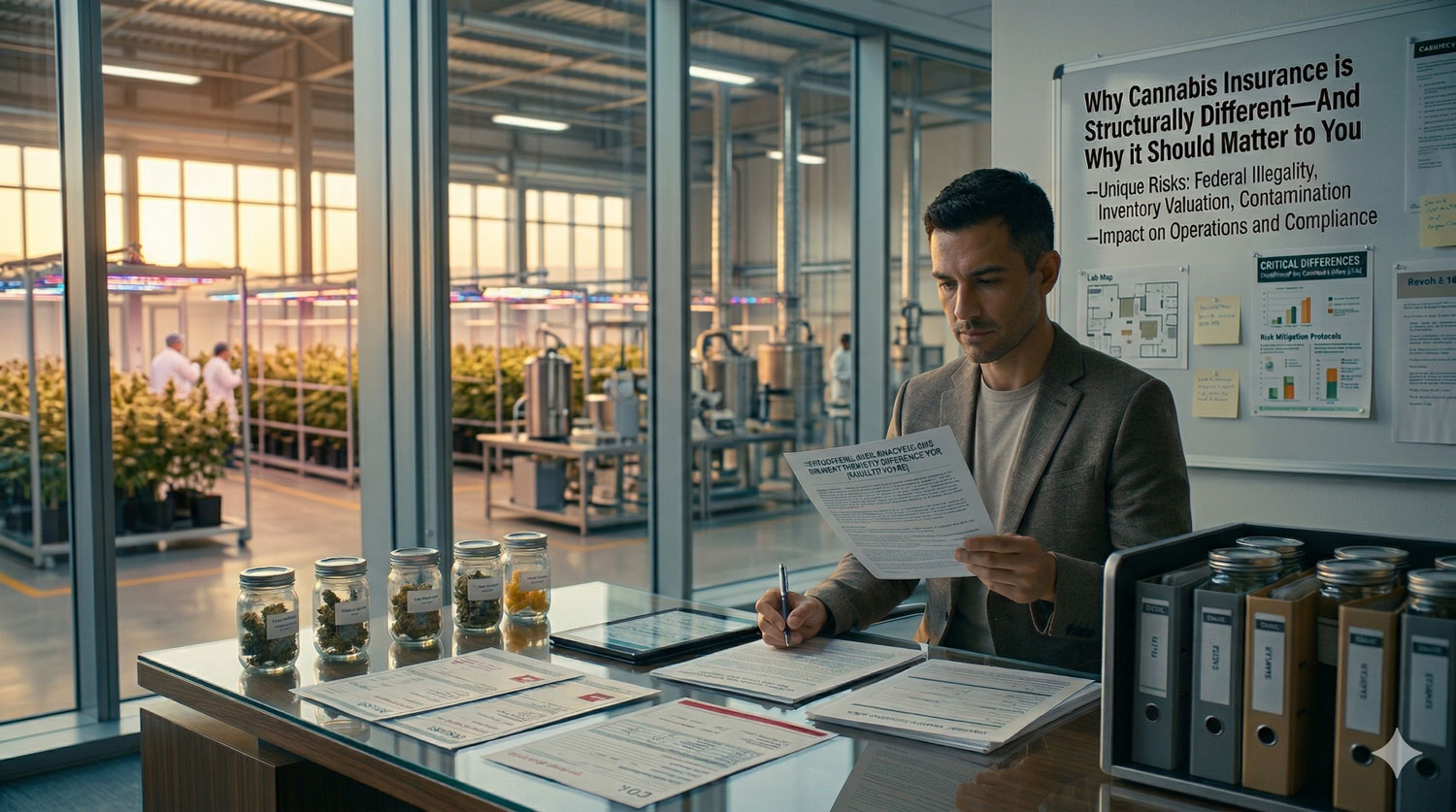
The cannabis industry has overcome regulatory barriers, banking restrictions, and decades of stigma to become one of the fastest-growing sectors in the U.S. economy. Yet cannabis businesses face an insurance market that functions unlike virtually any other industry—not because of anything operators are doing wrong, but because of how the market is fundamentally structured. Understanding why is one of the most consequential strategic conversations a cannabis business owner can have. It’s also one that 3F Captive Services is here to have with you.
The Root Cause: Federal Classification
At the center of the cannabis insurance problem is the Controlled Substances Act of 1970, which classifies cannabis as a Schedule I controlled substance. This has nothing to do with your state license or compliance record. It is a federal designation that shapes how commercial insurance works—or doesn’t—for your business.
Traditional commercial insurers maintain federally compliant reserve structures and answer to federal oversight bodies. Insuring a business that operates in conflict with federal law, regardless of state legality, creates an exposure profile most carriers will not accept. The result is a market failure: the vast majority of U.S. insurance capacity effectively does not exist for cannabis operators.
What the Surplus Lines Market Really Means…It Isn’t Good for You
The carriers willing to write cannabis coverage operate primarily through the surplus lines or excess and surplus (E&S) market—designed for risks that admitted carriers won’t write. That flexibility comes with a significant tradeoff: pricing power sits almost entirely with the carrier.
Without meaningful competition, cannabis operators find themselves in a near-monopolistic insurance environment. According to Milliman’s Cannabis Insurance Analysis, cannabis businesses pay premiums 3 to 5 times higher than comparable agricultural and retail operations. A multi-location dispensary that might pay $60,000 annually in a comparable legal industry can routinely face $200,000 or more—for coverage that is frequently thinner in the areas that matter most. As a result, you’ve been left with a lousy decision: leave your business far too exposed or overpay for insurance and still be more exposed than you’d like.
Coverage Gaps That Can Torpedo Your Business
The premium burden is only part of the structural problem. Standard commercial policies written for cannabis routinely exclude or severely limit some of the most significant exposures operators face:
- Product liability for edibles and concentrates is frequently restricted or subject to sub-limits that don’t reflect real-world exposure. A single mislabeled or contaminated product event can generate legal costs that exceed coverage limits many times over.
- Crop failure and inventory loss—critical for cultivation operations—are often excluded entirely or written on terms that make recovery difficult.
- Regulatory defense costs are a significant and frequently uninsured exposure. Legal defense expenses for a regulatory investigation can reach six figures before any formal action is ever taken.
- Equipment breakdown for specialized extraction and processing systems is frequently absent from cannabis commercial policies.
According to the Cannabis Business Times 2024 Industry Survey, 61% of cannabis operators rate insurance availability as a top-three business challenge (we wonder what the other 39% are thinking, by the way). The coverage problem is systemic, not situational.
Why This Matters Strategically
Cannabis businesses already operate under financial constraints that don’t apply to most industries. Section 280E prohibits ordinary business deductions, driving effective tax rates to 60% or higher for many operators. Banking access remains restricted. Compliance overhead is substantial and non-negotiable.
Into this already risky environment, inadequate insurance coverage introduces existential risk. An uninsured product liability claim, a catastrophic crop loss, or a regulatory action with no defense coverage can eliminate years of operational progress. For multi-location operators and vertically integrated enterprises, a single location’s uninsured exposure can threaten the entire organization.
The instinct to minimize insurance spend to reduce costs is understandable—but accepting thin coverage compounds risk at exactly the wrong time. The problem isn’t your risk management approach. The problem is the market itself, and market problems have market solutions.
A Market Solution to a Market Problem
Captive insurance was developed precisely because certain industries faced markets that systematically failed them. Medical malpractice in the 1970s, nuclear energy, pharmaceutical manufacturing—each built captive infrastructure when the traditional market proved structurally inadequate. Cannabis is following the same pattern for the same reasons.
A captive insurance company is a licensed insurer owned by the business it covers. Rather than sending premium dollars to a carrier who retains underwriting profit and may dispute your claims, you fund your own insurance vehicle—designed around your actual risk profile, with coverage built to address the exposures your operation actually faces. Underwriting profit stays inside your organization. Reserves build as assets you control. Instead of enriching an external insurance company, you enrich your company.
This isn’t a fringe strategy. It is a legitimate, regulated structure with decades of precedent. Captives have been around for decades and are used by companies in nearly every industry and by nearly all Fortune 500 Companies…and with good reason.
3F Captive Services works with licensed cannabis operators to evaluate fit, model financial outcomes, and manage the full formation and ongoing administration process. If a captive doesn’t make sense for your operation right now, we’ll tell you before you invest a dollar.
Sources
1. Milliman. Cannabis Insurance Analysis. Referenced in 3F Captive Services industry research.
2. Cannabis Business Times. 2024 State of the Cannabis Industry Survey. Cannabis Business Times, 2024.
3. Controlled Substances Act, 21 U.S.C. § 801 et seq. (1970).
4. National Association of Insurance Commissioners (NAIC). Surplus Lines Data Call. www.naic.org.
5. Internal Revenue Code § 280E, 26 U.S.C. § 280E.
Discover Tailored Insurance Solutions
Unlock the potential of customized captive insurance designed specifically for your unique business needs.