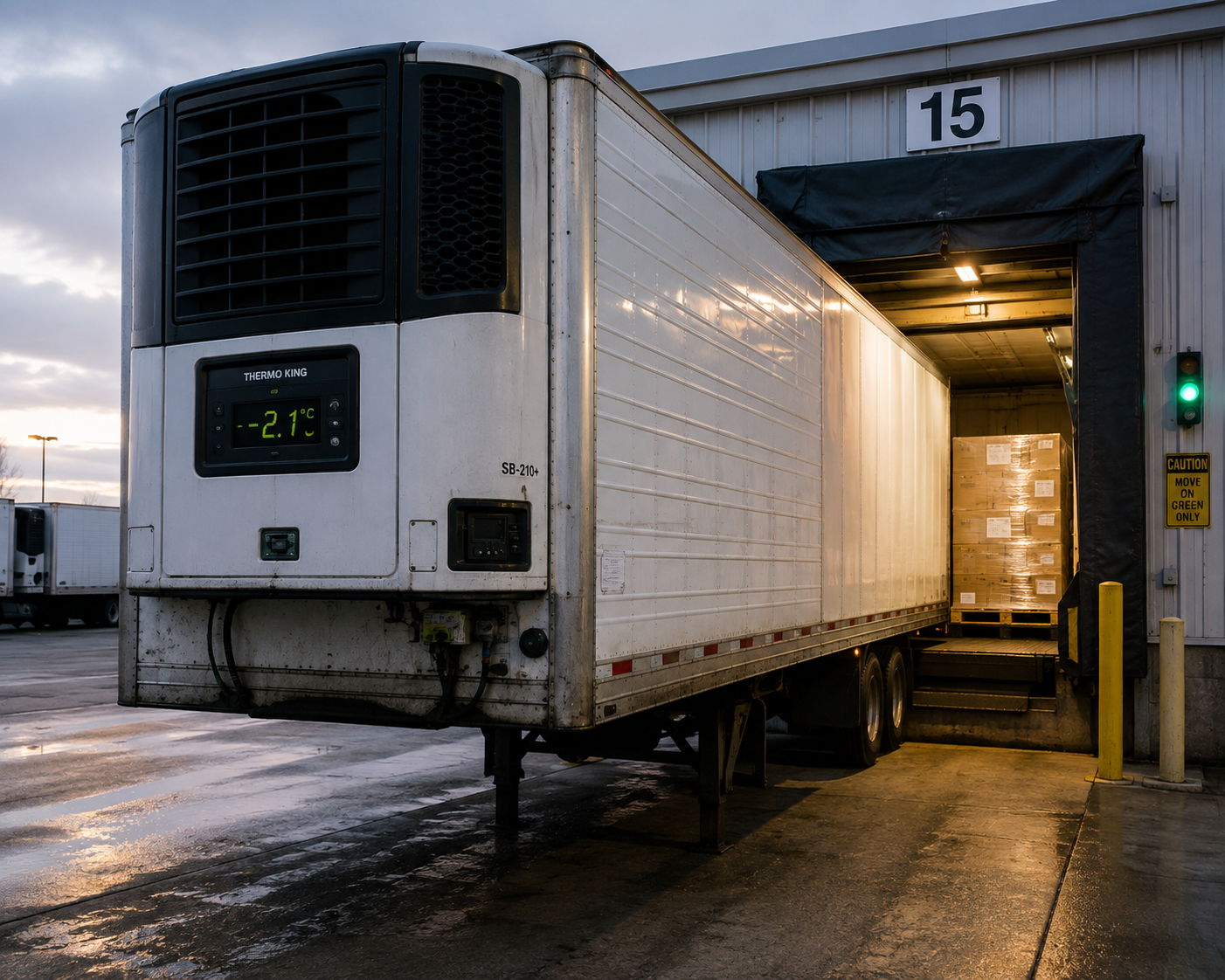
A reefer unit can die in complete silence, and by the time anyone notices, the freight inside it is already worthless, along with whatever you assumed your reefer breakdown coverage would pay.
The Failure Nobody Sees Coming
A reefer trailer is basically its own truck. It runs its own diesel engine, carries its own fuel tank, and has its own list of things that can go wrong, all bolted onto a trailer that has nothing to do with the tractor pulling it. That separation is the whole point of the design. It is also the whole problem.
When a tractor's engine runs into trouble, the driver gets a warning light, a check engine icon, maybe a limp mode that forces a stop. When a reefer's compressor fails, none of that happens. The box just starts warming up. A driver on a normal run might not open the trailer doors again until delivery. By then the freight inside has been sitting at the wrong temperature for hours, and nobody made a mistake to cause it. The compressor simply wore out, the way mechanical things do.
This is the part that trips up a lot of cold chain operators when they size up their own risk. It is not the same as a driver running a red light or missing a pickup window. There is no behavior to correct here. A well maintained reefer fleet still loses compressors, still loses evaporator fans, still develops refrigerant leaks nobody catches until the temperature chart shows a slow climb instead of a flat line. Mechanical failure is built into running temperature controlled equipment at all.
What a Blown Compressor Actually Costs
Here is a number worth sitting with, using an illustrative example rather than a real claim. A 53 foot reefer trailer is hauling $180,000 of frozen shrimp on a four hour run from a cold storage facility to a regional distribution center. Outside Bakersfield, the compressor dies. Nobody notices for a while, because nothing tells them to notice. Four hours later, the driver opens the doors at the dock and the receiving team's handheld thermometer reads 38 degrees Fahrenheit instead of 0.
The load gets rejected on the spot. Under most supply agreements, that is not a partial loss. It is a total one, because product that thawed and refroze, or sat above spec for any meaningful stretch, cannot legally be resold as the same product. The carrier now owes the shipper for a truckload it never delivered, on top of whatever it costs to tow, repair, or replace the reefer unit itself. Run that math across a fleet doing dozens of loads a week, and one bad compressor starts to look small next to the exposure sitting across the whole operation every day.
Why Your Cargo Policy May Not Pay
Here is where it gets worse. Most standard motor truck cargo policies were not built with cold chain freight as the primary concern. Spoilage and mechanical breakdown of refrigeration equipment show up on a lot of policies as a named exclusion, or as a sublimit so low it barely covers the cost of the tow, unless the carrier specifically bought a reefer breakdown endorsement.
Even when that endorsement exists, insurers commonly ask for one thing before they pay: proof. A continuous temperature recording device, the kind that logs box temperature every few minutes for the whole trip, is often the difference between a paid claim and a denied one. Without that data, an insurer has no reliable way to confirm the load actually failed, when it failed, or for how long. A driver's word that "the box got warm" is not underwriting evidence. If a fleet has not invested in that monitoring hardware, the coverage it thinks it has may functionally not exist the moment a claim comes in.
The Paper Trail the Law Already Requires
None of this happens in a regulatory vacuum. The U.S. Food and Drug Administration's (FDA) Sanitary Transportation of Human and Animal Food Rule, part of the Food Safety Modernization Act, already requires shippers, carriers, loaders, and receivers to maintain adequate temperature controls for food that needs them, and to be able to show it. That obligation exists whether or not the carrier has the insurance to back it up.
Pharma freight carries the same exposure with higher stakes. A 2012 report from the U.S. Department of Health and Human Services (HHS) Office of Inspector General found that 76 percent of the vaccine providers it reviewed had exposed vaccines to inappropriate temperatures for at least five cumulative hours over a two week period, with failures ranging from freezers running above threshold for days at a time to refrigerators drifting out of range without anyone catching it. That study looked at storage rather than transport, but the underlying problem is the same one a cold chain fleet faces on the road: temperature control fails quietly, and most operations do not have the visibility to catch it in real time. The International Air Transport Association (IATA) puts the pharmaceutical industry's annual cargo value moving through cold chain logistics at more than a trillion dollars. Even a small failure rate against a number that size adds up to a lot of ruined product.
A Captive Built Around Your Own Cold Chain Data
Here is the part most cold chain operators never get told. The commercial insurance market prices reefer breakdown and spoilage risk against the whole industry's loss experience, not against yours. A fleet that has invested in continuous monitoring, preventive maintenance schedules, and backup power for its reefer units pays into the same rate pool as a fleet that has none of that. The operator doing it right is subsidizing the one that isn't.
A captive changes that math. Instead of sending premium out the door to a carrier that prices you like the average fleet, you form your own insurance company and direct that premium into it. Under Internal Revenue Code (IRC) section 831(b), premiums paid to a qualifying captive are deductible by the parent company, and that premium is generally not taxed to the captive itself once it's inside, up to the 831(b) limit. The money doesn't get taxed on its way out of your operating company, nor taxed when it lands in the insurance company you own. The captive's realized investment income is still taxed, at the flat 21 percent federal corporate rate, generally lower than the top individual rate that money would otherwise face. If your fleet's actual loss experience is better than the market assumes, you keep the difference instead of handing it to a carrier as profit. The business writes the terms because the business owns the insurer.
This is not a fit for every operation. As a general guideline, not a hard rule, $250,000 in annual premium across all insurance policies is a reasonable starting point for whether the economics work, and that number can move lower in higher tax states where the 831(b) benefit strengthens the case on its own. For a cold chain fleet already tracking temperature data, maintenance records, and claims history, that data is exactly what turns a captive feasibility study into something grounded instead of speculative. You are not asking an actuary to guess at your risk. You already have the numbers. And you, not a commercial carrier, should be the one who benefits from them.
Contact 3F Captive Services for a no-cost policy analysis on your current cargo and reefer coverage. No pressure, no commitment, just a clear look at where your fleet actually stands today.
This article is for general informational purposes only and does not constitute insurance, legal, or tax advice. Coverage terms, exclusions, and endorsements vary by carrier and policy. Consult a licensed insurance professional and your own legal and tax advisors before making coverage or captive formation decisions.
Sources
1. U.S. Department of Health and Human Services, Office of Inspector General. "Vaccines for Children Program: Vulnerabilities in Vaccine Management," OEI-04-10-00430, 2012.
2. U.S. Food and Drug Administration. Sanitary Transportation of Human and Animal Food Rule, 21 CFR Part 1, Subpart O (Food Safety Modernization Act).
3. International Air Transport Association (IATA). CEIV Pharma cargo program overview, iata.org.
Discover Tailored Insurance Solutions
Unlock the potential of customized captive insurance designed specifically for your unique business needs.