
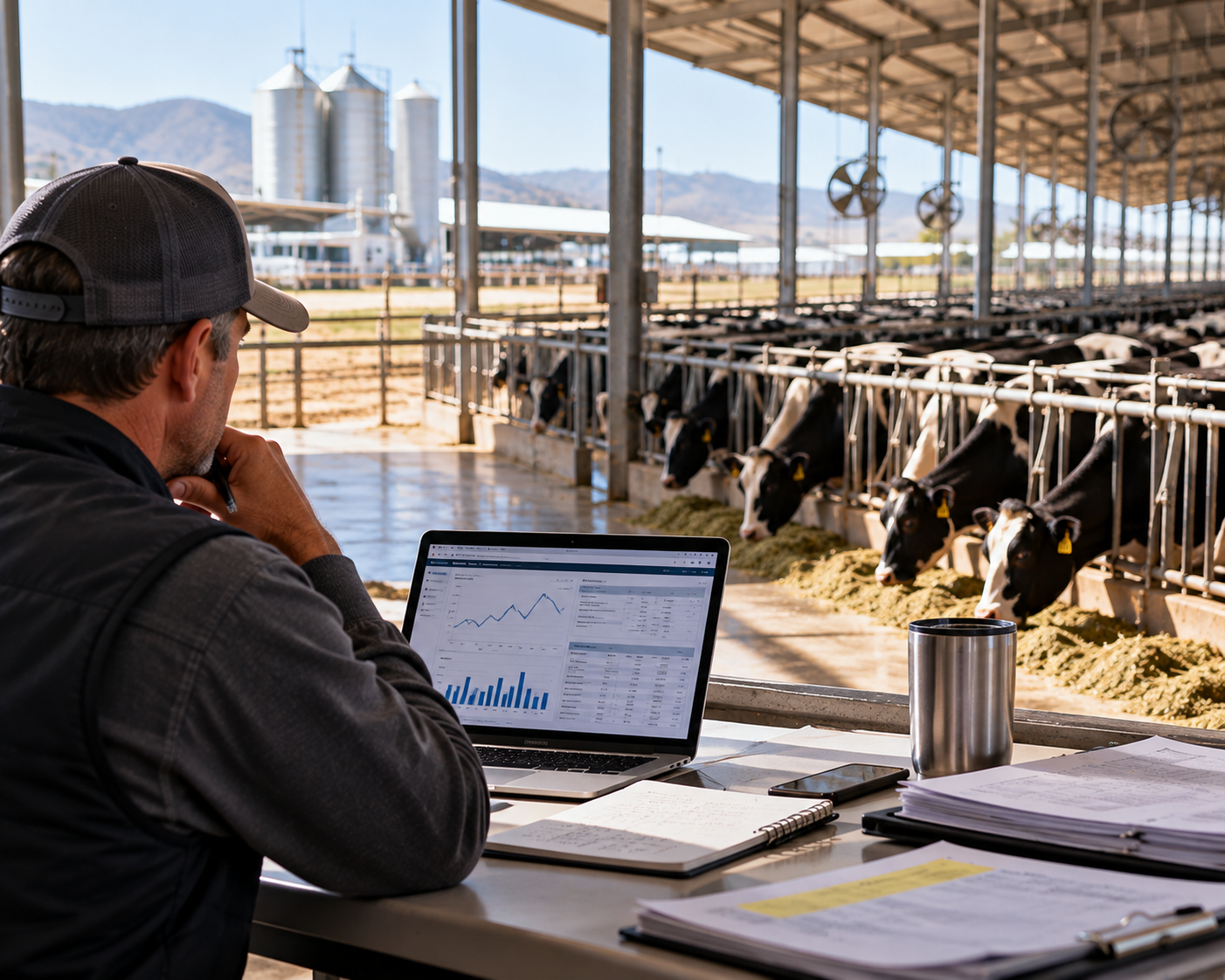
Dairy operations face a form of volatility that is both broader and more simultaneous than most agricultural enterprises. Milk prices swing under federal milk marketing order pricing structures. Herd health events — disease outbreaks, mastitis, reproductive failures — can reduce production and generate significant losses with little warning. Milking and cooling equipment failures can spoil an entire tank of milk in hours. Regulatory compliance requirements from the FDA and state dairy programs create ongoing exposure. Federal programs like Dairy Margin Coverage provide a subsidized baseline against margin pressure, but they address only part of the picture — and only up to the levels at which federal subsidies apply. The operational risks that sit outside those programs are largely self-insured, and a captive is the structure best suited to address them.
The Layered Risk Profile of a Dairy Operation
Dairy Margin Coverage — the primary federal risk management program for dairy operations — provides payments when the margin between milk price and feed costs falls below a defined threshold. Like MPCI and Whole Farm Revenue Protection for crop operations, DMC subsidies step back at higher coverage levels, leaving the upper margin band exposed. DMC also addresses only the margin relationship between milk prices and feed costs — it does not address herd health losses, equipment failures, spoilage events, environmental damage to facilities, or the regulatory and compliance exposures that dairy operations carry. Those risks are absorbed informally by most operations, out of operating cash, with no insurance recovery.
Herd health is among the most significant and least insured sources of operational loss in dairy. A disease outbreak — whether infectious bovine rhinotracheitis, bovine viral diarrhea, Johne’s disease, or a mastitis epidemic within a herd — can reduce milk production substantially, require significant veterinary intervention and culling costs, and generate production losses that persist long after the immediate event. Standard livestock policies address mortality in specific circumstances but rarely cover the full economic impact of a production-impairing herd health event. The gap between what livestock insurance pays and what a serious herd health event actually costs is typically large.
Equipment reliability is a distinct and acute exposure in dairy operations. Milking systems, bulk cooling tanks, and refrigeration equipment are mission-critical — a failure at the wrong point in the milking cycle can result in the loss of an entire tank of milk, which is an immediate and total loss. Standard farm equipment breakdown coverage may apply to the equipment itself, but the resulting milk spoilage loss is a separate category that standard policies often address inconsistently or not at all. For operations milking multiple times daily, the potential loss from a cooling failure between pickups is substantial.
Regulatory compliance exposure adds another layer specific to dairy. FDA Grade A program requirements, state dairy regulatory inspections, and USDA oversight of dairy operations create compliance obligations whose failure can result in suspension of milk marketability — a production shutdown that generates losses far exceeding any fine or penalty. The defense and response costs associated with a regulatory action, and the revenue loss during any period of restricted operations, are not covered by standard farm policies.
Every dairy operation is already self-insuring these exposures — absorbing herd health losses, spoilage events, and regulatory response costs out of operating funds when they occur. A captive formalizes that retained risk in a legitimate, licensed insurance company with actuary-priced policies. It can be structured to supplement DMC above the threshold where federal subsidies end, cover herd health production losses, address milk spoilage from equipment failure, and provide regulatory defense coverage that standard farm policies do not include. Premiums paid into the captive are invested and earn returns year after year, underwriting profit accumulates when operational losses stay below premium levels, and equity compounds over time into a genuine financial asset. These tasks and responsibilities are typically managed by the captive manager in coordination with the operation’s risk and financial advisors.
Key Points
• DMC covers the margin baseline, not the full picture: Dairy Margin Coverage addresses the relationship between milk prices and feed costs up to the levels where federal subsidies apply. It does not cover herd health losses, equipment failures, milk spoilage, or regulatory compliance exposures — the operational risks that generate significant losses independent of market conditions.
• Herd health is a major uninsured exposure: Disease outbreaks, mastitis, and other herd health events reduce production, generate culling and veterinary costs, and create losses that persist well beyond the immediate event. Standard livestock policies cover mortality in specific circumstances but rarely address the full economic impact of a production-impairing herd health loss.
• Equipment failure creates acute, total losses: Milking system and cooling equipment failures can result in the total loss of a milk tank with little warning. Standard equipment breakdown coverage may address the equipment itself; the spoilage loss is a separate and often inconsistently covered exposure.
• Regulatory compliance risk is real and uncovered: FDA Grade A program requirements and state dairy regulatory actions can result in suspension of milk marketability — a revenue shutdown whose financial impact is not covered by standard farm policies. Regulatory defense and response costs compound the exposure.
• A captive addresses what DMC and standard policies miss: A well-designed captive can supplement DMC above the federal subsidy threshold, cover herd health production losses, address milk spoilage from equipment failure, and provide regulatory defense coverage — building underwriting profit, investment income, and equity for the operation over time.
What is Dairy Margin Coverage and where does it leave gaps?
Dairy Margin Coverage is a federally subsidized program that provides payments to dairy producers when the national average margin — the difference between the all-milk price and a feed cost index — falls below a producer-selected threshold. It is the primary federal tool for protecting dairy operations against the simultaneous pressure of low milk prices and high feed costs. Like other federally subsidized agricultural programs, DMC subsidies step back at higher coverage levels. It also addresses only margin pressure — not the operational losses from herd health events, equipment failures, or regulatory actions that dairy operations face independent of milk and feed market conditions.
Does farm insurance cover milk spoilage from a cooling system failure?
Coverage for milk spoilage resulting from cooling system failure depends heavily on the specific policy language and how the loss is characterized. Standard farm equipment breakdown coverage may address the mechanical failure of the cooling unit but not the value of the spoiled milk itself. Some farm policies include spoilage coverage as an endorsement; others exclude it or apply sub-limits that do not reflect the actual value of a full tank. For dairy operations milking multiple times per day with significant per-tank values, this gap can be substantial. A captive can be structured to address milk spoilage losses with policy terms designed around the operation’s actual exposure.
Can a captive cover herd health losses in a dairy operation?
Yes. A captive can be structured to cover specific, insurable herd health losses — including production losses from disease outbreaks, culling costs resulting from herd health events, and veterinary and remediation expenses associated with a significant herd health incident. Standard livestock policies address mortality in specific circumstances but are not designed to capture the full economic impact of a production-impairing herd health event. A captive program built around the dairy operation’s actual risk profile can address these gaps with actuary-priced policies developed specifically for the operation.
How does captive insurance work alongside DMC for dairy operations?
DMC and a captive address different categories of risk and work as complementary tools rather than substitutes. DMC addresses margin pressure from milk price and feed cost movements up to the levels where federal subsidies apply. A captive supplements DMC above the threshold where that subsidized protection ends, and separately covers the operational risks DMC does not address at all — herd health production losses, milk spoilage, regulatory defense, and other specific exposures the commercial market handles poorly. A dairy operation using both maximizes coverage across the full range of risk it actually faces.
Common Misconceptions
“DMC covers our risk — we’re protected.”
DMC addresses margin pressure from milk price and feed cost movements up to the coverage levels where federal subsidies apply. It does not cover the operational risks that generate significant losses in dairy independent of market conditions — herd health events, equipment failures, milk spoilage, and regulatory compliance failures. A dairy operation that treats DMC as comprehensive risk management has significant uninsured exposure in precisely the categories most likely to generate an acute, large loss.
“Our livestock policy covers herd losses.”
Standard livestock policies are designed primarily around mortality coverage for specific named causes — not the full economic impact of a herd health event that reduces production, requires culling, and generates extended recovery costs. The gap between what a livestock mortality policy pays and what a serious herd health incident actually costs a dairy operation is typically large. A captive can be structured to cover the production losses, veterinary costs, and culling expenses that fall outside the livestock policy’s coverage framework.
“Milk price volatility is the biggest risk — that’s what we need to manage.”
Milk price volatility is real and well-recognized — and DMC, futures, and forward contracts are the appropriate tools for managing it. But for many dairy operations, the losses that actually threaten viability in a given year are operational: a disease event that cuts production for months, a cooling failure that costs a full tank, a regulatory action that suspends marketability. These are the risks that existing tools don’t address and that a captive is specifically suited to cover. A well-designed captive is a legitimate insurance company with actuary-priced policies built around the full range of risk a dairy operation actually faces.
Quick Summary
• Dairy operations face layered volatility — milk prices, herd health, equipment reliability, and regulatory compliance — that no single risk management tool addresses fully. DMC provides a federally subsidized baseline for margin risk but leaves significant operational exposures unaddressed.
• Herd health events, milk spoilage from equipment failure, and regulatory compliance losses are the risks most likely to generate acute, large losses in dairy — and the ones most poorly covered by existing commercial and federal programs.
• A captive can supplement DMC above the federal subsidy threshold and separately cover the operational risks DMC doesn’t address — building a program around the dairy operation’s actual exposure rather than what the commercial market will write.
• Underwriting profit when losses stay below premiums, investment income on reserves, and compounding equity over time — a captive turns the operational risk dairy producers already absorb into a financial asset rather than a recurring uninsured cost.
3F offers dairy operations a free exploratory analysis to explore if a captive is a good fit for a specific dairy operation.
Discover Tailored Insurance Solutions
Unlock the potential of customized captive insurance designed specifically for your unique business needs.